With an account of his
surprising the Fort at Gambia.
Davis was born in Monmouthshire, and,
from a boy, trained to the sea. His last
voyage from England was in the sloop Cadogan
from Bristol, in the character of chief
mate. This vessel was captured by the pirate
England, upon the Guinea coast, whose
companions plundered the crew, and murdered
the captain, as is related in England's
life.
Upon the death of Captain Skinner, Davis
pretended that he was urged by England to
become a pirate, but that he resolutely
refused. He added, that England, pleased
with his conduct, had made him captain in
room of Skinner, giving him a sealed paper,
which he was not to open until he was in a
certain latitude, and then expressly to
follow the given directions. When he arrived
in the appointed place, he collected the
whole crew, and solemnly read his sealed
instructions, which contained a generous
grant of the ship and all her stores to
Davis and his crew, requesting them to go to
Brazil, and dispose of the cargo to the best
advantage, and make an equal division of the
money.
Davis then commanded the crew to signify
whether they were inclined to follow that
mode of life, when, to his astonishment and
chagrin, the majority positively refused.
Then, in a transport of rage, he desired
them to go where they would.
Knowing that part of the cargo was
consigned to merchants in Barbadoes, they
directed their course to that place. When
arrived there, they informed the merchants
of the unfortunate death of Skinner, and of
the proposal which had been made to them.
Davis was accordingly seized, and committed
to prison, but he having never been in the
pirate service, nothing could be proved to
condemn him, and he was discharged without a
trial. Convinced that he could never hope
for employment in that quarter after this
detection, he went to the island of
Providence, which he knew to be a rendezvous
for pirates. Upon his arrival there, he was
grievously disappointed, because the pirates
who frequented that place had just accepted
of his majesty's pardon, and had
surrendered.
Captain Rogers having equipped two sloops
for trade, Davis obtained employment in one
of these, called the Buck. They were laden
with European goods to a considerable value,
which they were to sell or exchange with the
French and Spanish. They first touched at
the island of Martinique, belonging to the
French, and Davis knowing that many of the
men were formerly in the pirate service,
enticed them to seize the master, and to run
off with the sloop. When they had effected
their purpose, they hailed the other ship,
in which they knew that there were many
hands ripe for rebellion, and coming to, the
greater part joined Davis. Those who did not
choose to adhere to them were allowed to
remain in the other sloop, and continue
their course, after Davis had pillaged her
of what things he pleased.
In full possession of the vessel and
stores and goods, a large bowl of punch was
made; under its exhilarating influence, it
was proposed to choose a commander, and to
form their future mode of policy. The
election was soon over, and a large majority
of legal votes were in favor of Davis, and
no scrutiny demanded, Davis was declared
duly elected. He then drew up a code of
laws, to which he himself swore, and
required the same bond of alliance from all
the rest of the crew. He then addressed them
in a short and appropriate speech, the
substance of which was, a proclamation of
war with the whole world.
They next consulted, what part would be
most convenient to clean the vessel, and it
was resolved to repair to Coxon's Hole, at
the east end of the island of Cuba, where
they could remain in perfect security, as
the entrance was so narrow that one ship
could keep out a hundred.
They, however, had no small difficulty in
cleaning their vessel, as there was no
carpenter among them. They performed that
laborious task in the best manner they
could, and then made to the north side of
Hispaniola. The first sail they met with was
a French ship of twelve guns, which they
captured; and while they were plundering
her, another appeared in view. Enquiring of
the Frenchmen, they learned that she was a
ship of twenty-four guns and sixty men.
Davis proposed to his crew to attack her,
assuring them that she would prove a rich
prize. This appeared to the crew such a
hazardous enterprise, that they were rather
adverse to the measure. But he acquainted
them that he had conceived a stratagem that
he was confident would succeed; they might,
therefore, safely leave the matter to his
management. He then commenced chase, and
ordered his prize to do the same. Being a
better sailer, he soon came up with the
enemy, and showed his black colors. With no
small surprise at his insolence in coming so
near them, they commanded him to strike. He
replied, that he was disposed to give them
employment until his companion came up, who
was able to contend with them; meanwhile
assuring them that, if they did not strike
to him, it would most certainly fare the
worse for them: then giving them a
broadside, he received the same in return.
When the other pirate ship drew near,
they, according to the directions of Davis,
appeared upon deck in white shirts, which
making an appearance of numbers, the
Frenchman was intimidated, and struck. Davis
ordered the captain with twenty of his men
to come on board, and they were all put in
irons except the captain. He then despatched
four of his men to the other ship, and
calling aloud to them, desired that his
compliments should be given to the captain,
with a request to send a sufficient number
of hands to go on board their new prize, to
see what they had got in her. At the same
time, he gave them a written paper with
their proper instructions, even to nail up
the small guns, to take out all the arms and
powder, and to go every man on board the new
prize. When his men were on board her, he
ordered the greater part of the prisoners to
be removed into the empty vessels, and by
this means secured himself from any attempt
to recover their ship.
During three days, these three vessels
sailed in company, but finding that his late
prize was a heavy sailer, he emptied her of
everything that he stood in need of, and
then restored her to the captain with all
his men. The French captain was so much
enraged at being thus miserably deceived,
that, upon the discovery of the stratagem,
he would have thrown himself overboard, had
not his men prevented him.
Captain Davis then formed the resolution
of parting with the other prize-ship also,
and soon afterwards steered northward, and
took a Spanish sloop. He next directed his
course towards the western islands, and from
Cape de Verd islands cast anchor at St.
Nicholas, and hoisted English colors. The
Portuguese supposed that he was a privateer,
and Davis going on shore was hospitably
received, and they traded with him for such
articles as they found most advantageous. He
remained here five weeks, and he and half of
his crew visited the principal town of the
island. Davis, from his appearing in the
dress of a gentleman, was greatly caressed
by the Portuguese, and nothing was spared to
entertain and render him and his men happy.
Having amused themselves during a week, they
returned to the ship, and allowed the other
half of the crew to visit the capital, and
enjoy themselves in like manner. Upon their
return, they cleaned their ship and put to
sea, but four of the men were so captivated
with the ladies and the luxuries of the
place, that they remained in the island, and
one of them married and settled there.
Davis now sailed for Bonavista, and
perceiving nothing in that harbor steered
for the Isle of May. Arrived there, he found
several vessels in the harbor, and plundered
them of whatever he found necessary. He also
received a considerable reinforcement of
men, the greater part of whom entered
willingly into the piratical service. He
likewise made free with one of the ships,
equipped her for his own purpose, and called
her the King James. Davis next proceeded to
St. Jago to take in water. Davis, with some
others going on shore to seek water, the
governor came to inquire who they were, and
expressed his suspicion of their being
pirates. Upon this, Davis seemed highly
affronted, and expressed his displeasure in
the most polite but determined manner. He,
however, hastened on board, informed his
men, and suggested the possibility of
surprising the fort during the night.
Accordingly, all his men being well armed,
they advanced to the assault; and, from the
carelessness of the guards, they were in the
garrison before the inhabitants were
alarmed. Upon the discovery of their danger,
they took shelter in the governor's house,
and fortified it against the pirates: but
the latter throwing in some grando shells,
ruined the furniture, and killed several
people.
The alarm was circulated in the morning,
and the country assembled to attack them;
but, unwilling to stand a siege, the pirates
dismounted the guns, pillaged the fort, and
fled to their ships.
When at sea, they mustered their hands,
and found that they were seventy strong.
They then consulted among themselves what
course they should steer, and were divided
in opinion; but by a majority it was carried
to sail for Gambia, on the coast of Guinea.
Of this opinion was the captain, who having
been employed in that trade, was acquainted
with the coast; and informed his companions,
that there was always a large quantity of
money deposited in that castle, and he was
confident, if the matter was entrusted to
him, he should successfully storm that fort.
From their experience of his former prudence
and courage, they cheerfully submitted to
his direction, in the full assurance of
success.
Arrived at Gambia, he ordered all his men
below, except just so many as were necessary
to work the vessel, that those from the
fort, seeing so few hands, might have no
suspicion that she was any other than a
trading vessel. He then ran under the fort
and cast anchor, and having ordered out the
boat, manned with six men indifferently
dressed, he, with the master and doctor,
dressed themselves like gentlemen, in order
that the one party might look like
foremastmen, and the other like merchants.
In rowing ashore, he instructed his men what
to say if any questions were put to them by
the garrison.
On reaching land, the party was conducted
by a file of musqueteers into the fort, and
kindly received by the governor, who
enquired what they were, and whence they
came? They replied, that they were from
Liverpool, and bound for the river Senegal,
to trade for gum and elephants teeth; but
that they were chased on that coast by two
French men-of-war, and narrowly escaped
being taken. "We were now disposed,"
continued Davis, "to make the best of our
voyage, and would willingly trade here for
slaves." The governor then inquired what
were the principal articles of their cargo.
They replied, that they were iron and plate,
which were necessary articles in that place.
The governor then said, that he would give
them slaves for all their cargo; and asked
if they had any European liquor on board.
They answered, that they had a little for
their own use, but that he should have a
hamper of it. He then treated them with the
greatest civility, and desired them all to
dine with him. Davis answered, that as he
was commander of the vessel, it would be
necessary for him to go down to see if she
were properly moored, and to give some other
directions; but that these gentlemen might
stay, and he would return before dinner, and
bring the hamper with him.
While in the fort, his eyes were keenly
employed to discover the position of the
arms, and how the fort might most
successfully be surprised. He discovered
that there was a sentry standing near a
guard-house, in which there were a quantity
of arms heaped up in a corner, and that a
considerable number of small arms were in
the governor's hall. When he went on board,
he ordered some hands on board a sloop lying
at anchor, lest, hearing any bustle they
should come to the aid of the castle; then
desiring his men to avoid too much liquor,
and to be ready when he should hoist the
flag from the walls, to come to his
assistance, he proceeded to the castle.
Having taken these precautions and formed
these arrangements, he ordered every man who
was to accompany him to arm himself with two
pair of pistols, which he himself also did,
concealed under their clothes. He then
directed them to go into the guard-room, and
fall into conversation, and immediately upon
his firing a pistol out of the governor's
window, to shut the men up, and secure the
arms in the guard-room.
When Davis arrived, dinner not being
ready, the governor proposed that they
should pass the time in making a bowl of
punch. Davis's boatswain attending him, had
an opportunity of visiting all parts of the
house, and observing their strength. He
whispered his intelligence to his master,
who being surrounded by his own friends, and
seeing the governor unattended by any of his
retinue, presented a pistol to the breast of
the latter, informing him that he was a dead
man, unless he should surrender the fort and
all its riches. The governor, thus taken by
surprise, was compelled to submit; for Davis
took down all the pistols that hung in the
hall, and loaded them. He then fired his
pistol out of the window. His men flew like
lions, presented their pistols to the
soldiers, and while some carried out the
arms, the rest secured the military, and
shut them all up in the guard-house, placing
a guard on the door. Then one of them struck
the union flag on the top of the castle,
which the men from the vessel perceiving,
rushed to the combat, and in an instant were
in possession of the castle, without tumult
or bloodshed.
Davis then harrangued the soldiers, many
of whom enlisted with him; and those who
declined, he put on board the small ships,
and to prevent the necessity of a guard, or
the possibility of escape, carried off the
sails, rigging and cables.
That day being spent in feasting and
rejoicing, the castle saluting the ship, and
the ship the castle, on the day following
they proceeded to examine the contents of
their prize. They, however, were greatly
disappointed in their expectations, a large
sum of money having been sent off a few days
before. But they found money to the amount
of about two thousand pounds in gold, and
many valuable articles of different kinds.
They carried on board their vessel whatever
they deemed useful, gave several articles to
the captain and crew of the small vessel,
and allowed them to depart, while they
dismounted the guns, and demolished the
fortifications.
After doing all the mischief that their
vicious minds could possibly devise, they
weighed anchor; but in the mean time,
perceiving a sail bearing towards them with
all possible speed, they hastened to prepare
for her reception, and made towards her.
Upon her near approach they discovered that
she was a French pirate of fourteen guns and
sixty-four men, the one half French, and the
other half negroes.
The Frenchman was in high expectation of
a rich prize, but when he came nearer, he
suspected, from the number of her guns and
men, that she was a small English
man-of-war; he determined, notwithstanding,
upon the bold attempt of boarding her, and
immediately fired a gun, and hoisted his
black colors: Davis immediately returned the
compliment. The Frenchman was highly
gratified at this discovery; both hoisted
out their boats, and congratulated each
other. Mutual civilities and good offices
passed, and the French captain proposed to
Davis to sail down the coast with him, in
order to look out for a better ship,
assuring him that the very first that could
be captured should be his, as he was always
willing to encourage an industrious brother.
They first touched at Sierra Leone, where
they espied a large vessel, and Davis being
the swifter sailer, came first up with him.
He was not a little surprised that she did
not endeavor to make off, and began to
suspect her strength. When he came alongside
of her, she fired a whole broadside, and
hoisted black colors. Davis did the same,
and fired a gun to leeward. The satisfaction
of these brothers in iniquity was mutual, at
having thus acquired so much additional
strength and ability to undertake more
formidable adventures. Two days were devoted
to mirth and song, and upon the third, Davis
and Cochlyn, the captain of the new
confederate, agreed to go in the French
pirate ship to attack the fort. When they
approached, the men in the fort,
apprehensive of their character and
intentions, fired all the guns upon them at
once. The ship returned the fire, and
afforded employment until the other two
ships arrived, when the men in the fort
seeing such a number on board, lost courage,
and abandoned the fort to the mercy of the
robbers.
They took possession, remained there
seven weeks, and cleaned their vessels. They
then called a council of war, to deliberate
concerning future undertakings, when it was
resolved to sail down the coast in company;
and, for the greater regularity and
grandeur, Davis was chosen Commodore. That
dangerous enemy, strong drink, had well
nigh, however, sown the seeds of discord
among these affectionate brethren. But
Davis, alike prepared for council or for
war, addressed them to the following
purport: "Hear ye, you Cochlyn and La Boise,
(which was the name of the French captain) I
find, by strengthening you, I have put a rod
into your hands to whip myself; but I am
still able to deal with you both: however,
since we met in love, let us part in love;
for I find that three of a trade can never
agree long together." Upon this, the other
two went on board of their respective ships,
and steered different courses.
Davis held down the coast, and reaching
Cape Appolonia he captured three vessels,
two English and one Scottish, plundered
them, and allowed them to proceed. In five
days after he met with a Dutchman of thirty
guns and ninety men. She gave Davis a
broadside, and killed nine of his men; a
desperate engagement ensued, which continued
from one o'clock at noon until nine next
morning, when the Dutchman struck.
Davis equipped her for the pirate
service, and called her "The Rover." With
his two ships he sailed for the bay of
Anamaboa, which he entered about noon, and
took several vessels which were there
waiting to take in negroes, gold, and
elephants' teeth. Davis made a present of
one of these vessels to the Dutch captain
and his crew, and allowed them to go in
quest of their fortune. When the fort had
intelligence that they were pirates, they
fired at them, but without any effect; Davis
fired also, and hoisted the black colors,
but deemed it prudent to depart.
The next day after he left Anamaboa, the
man at the mast-head discovered a sail. It
may be proper to inform our readers, that,
according to the laws of pirates, the man
who first discovers a vessel, is entitled to
the best pair of pistols in the ship, and
such is the honor attached to these, that a
pair of them has been known to sell for
thirty pounds.
Davis pursued that vessel, which, being
between him and the shore, labored hard to
run aground. Davis perceiving this, got
between her and the land, and fired a
broadside at her, when she immediately
struck. She proved to be a very rich prize,
having on board the Governor of Acra, with
all his substance, going to Holland. There
was in money to the amount of fifteen
thousand pounds, besides a large quantity of
merchant goods, and other valuable articles.
Before they reached the Isle of Princes,
the St. James sprang a leak, so that the men
and the valuable articles were removed into
Davis's own ship. When he came in sight of
the fort he hoisted English colors. The
Portuguese, seeing a large ship sailing
towards the shore, sent a sloop to discover
her character and destination. Davis
informed them, that he was an English
man-of-war, sent out in search of some
pirates which they had heard were in this
quarter. Upon this, he was piloted into the
port, and anchored below the guns at the
fort. The governor was happy to have
Englishmen in his harbor; and to do honor to
Davis, sent down a file of musqueteers to
escort him into the fort, while Davis, the
more to cover his design, ordered nine men,
according to the custom of the English, to
row him on shore.
Davis also took the opportunity of
cleaning and preparing all things for
renewing his operations. He, however, could
not contentedly leave the fort, without
receiving some of the riches of the island.
He formed a scheme to accomplish his
purpose, and communicated the same to his
men. He design was to make the governor a
present of a few negroes in return for his
kindness; then to invite him, with a few of
the principal men and friars belonging to
the island, to dine on board his ship, and
secure them all in irons, until each of them
should give a large ransom. They were
accordingly invited, and very readily
consented to go: and deeming themselves
honored by his attention, all that were
invited, would certainly have gone on board.
Fortunately however, for them, a negro, who
was privy to the horrible plan of Davis,
swam on shore during the night, and gave
information of the danger to the governor.
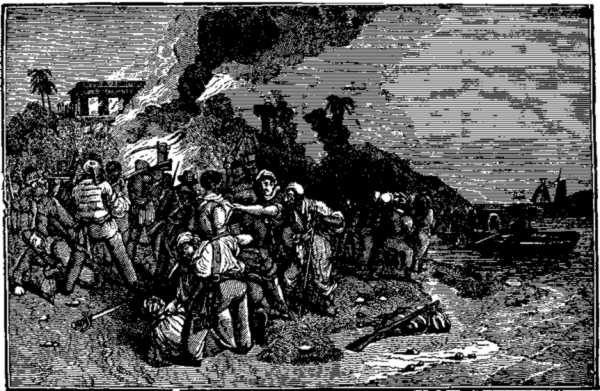
Retreat of the Pirates and Death of
Captain Davis.
The governor occupied the whole night in
strengthening the defences and posting the
men in the most advantageous places. Soon
after day-break, the pirates, with Captain
Davis at their head were discovered landing
from the boats; and quickly marched across
the open space toward the fort. A brisk fire
was opened upon them from the fort, which
they returned in a spirited manner. At
length, a hand grenade, thrown from the
wooden veranda of the fort killed three of
the pirates; but several of the Portuguese
were killed. The veranda of the fort being
of wood and very dry, it was set fire to by
the pirates. This was a great advantage to
the attacking party, who could now
distinguish those in the fort without their
being so clearly seen themselves; but at
this moment Captain Davis fell, mortally
wounded by a musket ball in his belly. The
fall of their chief, and the determined
resistance of those in the fort, checked the
impetuosity of the assailants. They
hesitated, and at last retreated, bearing
away with them their wounded commander. The
Portuguese cheered, and led on by the
governor, now became the assailants. Still
the pirates' retreat was orderly; they fired
and retired rank behind rank successively.
They kept the Portuguese at bay until they
had arrived at the boats, when a charge was
made and a severe conflict ensued. But the
pirates had lost too many men; and without
their Captain, felt dispirited. As they
lifted Davis into the boat in his dying
agonies he fired his pistols at his
pursuers. They now pulled with all their
might to escape from the muskets of the
Portuguese, who followed them along the
banks of the river, annoying them in their
retreat to the vessel. And those on board,
who expected to hoist in treasure had to
receive naught but their wounded comrades
and dead commander.
 |