PORTO BELLO AND PANAMA
On 4th January 1664, the king
wrote to Sir Thomas Modyford in
Barbadoes that he had chosen him
governor of Jamaica.206
Modyford, who had lived as a planter
in Barbadoes since 1650, had taken a
prominent share in the struggles
between Parliamentarians and
Royalists in the little island. He
was a member of the Council, and had
been governor for a short time in
1660. His commission and
instructions for Jamaica207
were carried to the West Indies by
Colonel Edward Morgan, who went as
Modyford's deputy-governor and
landed in Barbadoes on 21st April.208
Modyford was instructed, among other
things, to prohibit the granting of
letters of marque, and particularly
to encourage trade and maintain
friendly relations with the Spanish
dominions. Sir Richard Fanshaw had
just been appointed to go to Spain
and negotiate a treaty for wider
commercial privileges in the Indies,
and Charles saw that the daily
complaints of violence and
depredation done by Jamaican ships
on the King of Spain's subjects were
scarcely calculated to increase the
good-will and compliance of the
Spanish Court. Nor had the attempt
in the Indies to force a trade upon
the Spaniards been brilliantly
successful. It was soon evident that
another course of action was
demanded. Sir Thomas Modyford seems
at first to have been sincerely anxious to suppress
privateering and conciliate his
Spanish neighbours. On receiving his
commission and instructions he
immediately prepared letters to the
President of San Domingo, expressing
his fair intentions and requesting
the co-operation of the Spaniards.209
Modyford himself arrived in Jamaica
on 1st June,210
proclaimed an entire cessation of
hostilities,211
and on the 16th sent the "Swallow"
ketch to Cartagena to acquaint the
governor with what he had done. On
almost the same day letters were
forwarded from England and from
Ambassador Fanshaw in Madrid,
strictly forbidding all violences in
the future against the Spanish
nation, and ordering Modyford to
inflict condign punishment on every
offender, and make entire
restitution and satisfaction to the
sufferers.212
The letters for San Domingo,
which had been forwarded to Jamaica
with Colonel Morgan and thence
dispatched to Hispaniola before
Modyford's arrival, received a
favourable answer, but that was
about as far as the matter ever got.
The buccaneers, moreover, the
principal grievance of the
Spaniards, still remained at large.
As Thomas Lynch wrote on 25th May,
"It is not in the power of the
governor to have or suffer a
commerce, nor will any necessity or
advantage bring private Spaniards to
Jamaica, for we and they have used
too many mutual barbarisms to have a
sudden correspondence. When the king
was restored, the Spaniards thought
the manners of the English nation
changed too, and adventured twenty
or thirty vessels to Jamaica for
blacks, but the surprises and
irruptions by C. Myngs, for whom the
governor of San Domingo has
upbraided the commissioners, made
the Spaniards redouble their malice,
and nothing but an order from Spain
can give us admittance or
trade."213
For a short time, however, a serious
effort was made to recall the
privateers. Several prizes which
were brought into Port Royal were
seized and returned to their owners,
while the captors had their
commissions taken from them. Such
was the experience of one Captain
Searles, who in August brought in
two Spanish vessels, both of which
were restored to the Spaniards, and
Searles deprived of his rudder and
sails as security against his making
further depredations upon the Dons.214
In November Captain Morris Williams
sent a note to Governor Modyford,
offering to come in with a rich
prize of logwood, indigo and silver,
if security were given that it
should be condemned to him for the
payment of his debts in Jamaica; and
although the governor refused to
give any promises the prize was
brought in eight days later. The
goods were seized and sold in the
interest of the Spanish owner.215
Nevertheless, the effects of the
proclamation were not at all
encouraging. In the first month only
three privateers came in with their
commissions, and Modyford wrote to
Secretary Bennet on 30th June that
he feared the only effect of the
proclamation would be to drive them
to the French in Tortuga. He
therefore thought it prudent, he
continued, to dispense somewhat with
the strictness of his instructions,
"doing by degrees and moderation
what he had at first resolved to
execute suddenly and severely."216
Tortuga was really the crux of
the whole difficulty. Back in 1662
Colonel Doyley, in his report to the
Lord Chancellor after his return to
England, had suggested the reduction of Tortuga to
English obedience as the only
effective way of dealing with the
buccaneers;217
and Modyford in 1664 also realized
the necessity of this preliminary
step.218
The conquest of Tortuga, however,
was no longer the simple task it
might have been four or five years
earlier. The inhabitants of the
island were now almost entirely
French, and with their companions on
the coast of Hispaniola had no
intention of submitting to English
dictation. The buccaneers, who had
become numerous and independent and
made Tortuga one of their principal
retreats, would throw all their
strength in the balance against an
expedition the avowed object of
whose coming was to make their
profession impossible. The colony,
moreover, received an incalculable
accession of strength in the arrival
of Bertrand d'Ogeron, the governor
sent out in 1665 by the new French
West India Company. D'Ogeron was one
of the most remarkable figures in
the West Indies in the second half
of the seventeenth century. Of broad
imagination and singular kindness of
heart, with an indomitable will and
a mind full of resource, he seems to
have been an ideal man for the task,
not only of reducing to some
semblance of law and order a people
who had never given obedience to any
authority, but also of making
palatable the régime and
exclusive privileges of a private
trading company. D'Ogeron first
established himself at Port Margot
on the coast of Hispaniola opposite
Tortuga in the early part of 1665;
and here the adventurers at once
gave him to understand that they
would never submit to any mere
company, much less suffer an
interruption of their trade with the
Dutch, who had supplied them with
necessities at a time when it was
not even known in France that there
were Frenchmen in that region. D'Ogeron pretended to
subscribe to these conditions,
passed over to Tortuga where he
received the submission of la Place,
and then to Petit-Goave and Leogane,
in the cul-de-sac of
Hispaniola. There he made his
headquarters, adopted every means to
attract planters and engagés,
and firmly established his
authority. He made advances from his
own purse without interest to
adventurers who wished to settle
down to planting, bought two ships
to facilitate trade between the
colony and France, and even
contrived to have several lots of
fifty women each brought over from
France to be sold and distributed as
wives amongst the colonists. The
settlements soon put on a new air of
prosperity, and really owed their
existence as a permanent French
colony to the efforts of this new
governor.219
It was under the administration of
d'Ogeron that l'Olonnais,220
Michel le Basque, and most of the
French buccaneers flourished, whose
exploits are celebrated in
Exquemelin's history.
The conquest of Tortuga was not
the only measure necessary for the
effectual suppression of the
buccaneers. Five or six swift
cruisers were also required to
pursue and bring to bay those
corsairs who refused to come in with
their commissions.221
Since the Restoration the West
Indies had been entirely denuded of
English men-of-war; while the
buccaneers, with the tacit consent
or encouragement of Doyley, had at
the same time increased both in
numbers and boldness. Letters
written from Jamaica in 1664 placed
the number scattered abroad in
privateering at from 1500 to 2000,
sailing in fourteen or fifteen
ships.222
They were desperate men, accustomed
to living at sea, with no trade but
burning and plundering, and unlikely to take orders from any
but stronger and faster frigates.
Nor was this condition of affairs
surprising when we consider that, in
the seventeenth century, there
flowed from Europe to the West
Indies adventurers from every class
of society; men doubtless often
endowed with strong personalities,
enterprising and intrepid; but
often, too, of mediocre intelligence
or little education, and usually
without either money or scruples.
They included many who had revolted
from the narrow social laws of
European countries, and were
disinclined to live peaceably within
the bounds of any organized society.
Many, too, had belonged to
rebellious political factions at
home, men of the better classes who
were banished or who emigrated in
order to keep their heads upon their
shoulders. In France the total
exhaustion of public and private
fortune at the end of the religious
wars disposed many to seek to recoup
themselves out of the immense
colonial riches of the Spaniards;
while the disorders of the Rebellion
and the Commonwealth in England
caused successive emigrations of
Puritans and Loyalists to the newer
England beyond the seas. At the
close of the Thirty Years' War, too,
a host of French and English
adventurers, who had fattened upon
Germany and her misfortunes, were
left without a livelihood, and
doubtless many resorted to
emigration as the sole means of
continuing their life of freedom and
even of licence. Coming to the West
Indies these men, so various in
origin and character, hoped soon to
acquire there the riches which they
lost or coveted at home; and their
expectations deceived, they often
broke in a formal and absolute
manner the bonds which attached them
to their fellow humanity. Jamaica
especially suffered in this respect,
for it had been colonized in the
first instance by a discontented,
refractory soldiery, and it was
being recruited largely by
transported criminals and vagabonds.
In contrast with the policy of
Spain, who placed the most careful
restrictions upon the class of
emigrants sent to her American
possessions, England from the very
beginning used her colonies, and
especially the West Indian islands,
as a dumping-ground for her refuse
population. Within a short time a
regular trade sprang up for
furnishing the colonies with servile
labour from the prisons of the
mother country. Scots captured at
the battles of Dunbar and Worcester,223
English, French, Irish and Dutch
pirates lying in the gaols of
Dorchester and Plymouth,224
if "not thought fit to be tried for
their lives," were shipped to
Barbadoes, Jamaica, and the other
Antilles. In August 1656 the Council
of State issued an order for the
apprehension of all lewd and
dangerous persons, rogues, vagrants
and other idlers who had no way of
livelihood and refused to work, to
be transported by contractors to the
English plantations in America;225
and in June 1661 the Council for
Foreign Plantations appointed a
committee to consider the same
matter.226
Complaints were often made that
children and apprentices were
"seduced or spirited away" from
their parents and masters and
concealed upon ships sailing for the
colonies; and an office of registry was
established to prevent this abuse.227
In 1664 Charles granted a licence
for five years to Sir James
Modyford, brother of Sir Thomas, to
take all felons convicted in the
circuits and at the Old Bailey who
were afterwards reprieved for
transportation to foreign
plantations, and to transmit them to
the governor of Jamaica;228
and this practice was continued
throughout the whole of the
buccaneering period.
Privateering opened a channel by
which these disorderly spirits,
impatient of the sober and laborious
life of the planter, found an
employment agreeable to their
tastes. An example had been set by
the plundering expeditions sent out
by Fortescue, Brayne and Doyley, and
when these naval excursions ceased,
the sailors and others who had taken
part in them fell to robbing on
their private account. Sir Charles
Lyttleton, we have seen, zealously
defended and encouraged the
freebooters; and Long, the historian
of Jamaica, justified their
existence on the ground that many
traders were attracted to the island
by the plunder with which Port Royal
was so abundantly stocked, and that
the prosperity of the colony was
founded upon the great demand for
provisions for the outfit of the
privateers. These effects, however,
were but temporary and superficial,
and did not counterbalance the
manifest evils of the practice,
especially the discouragement to
planting, and the element of
turbulence and unrest ever present
in the island. Under such conditions
Governor Modyford found it necessary
to temporise with the marauders, and
perhaps he did so the more readily
because he felt that they were still
needed for the security of the
colony. A war between England and
the States-General then seemed
imminent, and the governor
considered that unless he allowed
the buccaneers to dispose of their
booty when they came in to
Port Royal, they might, in event of
hostilities breaking out, go to the
Dutch at Curaçao and other islands,
and prey upon Jamaican commerce. On
the other hand, if, by adopting a
conciliatory attitude, he retained
their allegiance, they would offer
the handiest and most effective
instrument for driving the Dutch
themselves out of the Indies.229
He privately told one captain, who
brought in a Spanish prize, that he
only stopped the Admiralty
proceedings to "give a good relish
to the Spaniard"; and that although
the captor should have satisfaction,
the governor could not guarantee him
his ship. So Sir Thomas persuaded
some merchants to buy the
prize-goods and contributed one
quarter of the money himself, with
the understanding that he should
receive nothing if the Spaniards
came to claim their property.230
A letter from Secretary Bennet, on
12th November 1664, confirmed the
governor in this course;231
and on 2nd February 1665, three
weeks before the declaration of war
against Holland, a warrant was
issued to the Duke of York, High
Admiral of England, to grant,
through the colonial governors and
vice-admirals, commissions of
reprisal upon the ships and goods of
the Dutch.232
Modyford at once took advantage of
this liberty. Some fourteen pirates,
who in the beginning of February had
been tried and condemned to death,
were pardoned; and public
declaration was made that
commissions would be granted against
the Hollanders. Before nightfall two
commissions had been taken out, and
all the rovers were making
applications and planning how to
seize Curaçao.233
Modyford drew up an elaborate design234
for rooting out at one and the same
time the Dutch settlements and the
French buccaneers, and on 20th April
he wrote that
Lieutenant-Colonel Morgan had sailed
with ten ships and some 500 men,
chiefly "reformed prisoners,"
resolute fellows, and well armed
with fusees and pistols.235
Their plan was to fall upon the
Dutch fleet trading at St. Kitts,
capture St. Eustatius, Saba, and
perhaps Curaçao, and on the homeward
voyage visit the French settlements
on Hispaniola and Tortuga. "All this
is prepared," he wrote, "by the
honest privateer, at the old rate of
no purchase no pay, and it will cost
the king nothing considerable, some
powder and mortar-pieces." On the
same day, 20th April, Admiral de
Ruyter, who had arrived in the
Indies with a fleet of fourteen
sail, attacked the forts and
shipping at Barbadoes, but suffered
considerable damage and retired
after a few hours. At Montserrat and
Nevis, however, he was more
successful and captured sixteen
merchant ships, after which he
sailed for Virginia and New York.236
The buccaneers enrolled in
Colonel Morgan's expedition proved
to be troublesome allies. Before
their departure from Jamaica most of
them mutinied, and refused to sail
until promised by Morgan that the
plunder should be equally divided.237
On 17th July, however, the
expedition made its rendezvous at
Montserrat, and on the 23rd arrived
before St. Eustatius. Two vessels
had been lost sight of, a third,
with the ironical name of the "Olive
Branch," had sailed for Virginia,
and many stragglers had been left
behind at Montserrat, so that Morgan
could muster only 326 men for the
assault. There was only one
landing-place on the island, with a
narrow path accommodating but two
men at a time leading to an eminence
which was crowned with a fort and
450 Dutchmen. Morgan landed his
division first, and Colonel Carey
followed. The enemy, it seems, gave
them but one small volley and then
retreated to the fort. The governor
sent forward three men to parley,
and on receiving a summons to
surrender, delivered up the fort
with eleven large guns and
considerable ammunition. "It is
supposed they were drunk or mad,"
was the comment made upon the rather
disgraceful defence.238
During the action Colonel Morgan,
who was an old man and very
corpulent, was overcome by the hard
marching and extraordinary heat, and
died. Colonel Carey, who succeeded
him in command, was anxious to
proceed at once to the capture of
the Dutch forts on Saba, St. Martins
and Tortola; but the buccaneers
refused to stir until the booty got
at St. Eustatius was divided—nor
were the officers and men able to
agree on the manner of sharing. The
plunder, besides guns and
ammunition, included about 900
slaves, negro and Indian, with a
large quantity of live stock and
cotton. Meanwhile a party of seventy
had crossed over to the island of
Saba, only four leagues distant, and
secured its surrender on the same
terms as St. Eustatius. As the men
had now become very mutinous, and on
a muster numbered scarcely 250, the
officers decided that they could not
reasonably proceed any further and
sailed for Jamaica, leaving a small
garrison on each of the islands.
Most of the Dutch, about 250 in
number, were sent to St. Martins,
but a few others, with some
threescore English, Irish and
Scotch, took the oath of allegiance
and remained.239
Encouraged by a letter from the
king,240
Governor Modyford continued his
exertions against the Dutch. In
January (?) 1666 two buccaneer
captains, Searles and Stedman, with
two small ships and only eighty men
took the island of Tobago, near
Trinidad, and destroyed everything
they could not carry away. Lord
Willoughby, governor of Barbadoes,
had also fitted out an expedition to
take the island, but the Jamaicans
were three or four days before him.
The latter were busy with their work
of pillage, when Willoughby arrived
and demanded the island in the name
of the king; and the buccaneers
condescended to leave the fort and
the governor's house standing only
on condition that Willoughby gave
them liberty to sell their plunder
in Barbadoes.241
Modyford, meanwhile, greatly
disappointed by the miscarriage of
the design against Curaçao, called
in the aid of the "old privateer,"
Captain Edward Mansfield, and in the
autumn of 1665, with the hope of
sending another armament against the
island, appointed a rendezvous for
the buccaneers in Bluefields Bay.242
In January 1666 war against
England was openly declared by
France in support of her Dutch
allies, and in the following month
Charles II. sent letters to his
governors in the West Indies and the
North American colonies, apprising
them of the war and urging them to
attack their French neighbours.243
The news of the outbreak of
hostilities did not reach Jamaica
until 2nd July, but already in
December of the previous year
warning had been sent out to the
West Indies of the coming rupture.244
Governor Modyford, therefore, seeing
the French very much increased in
Hispaniola, concluded that it was
high time to entice the buccaneers
from French service and bind them to
himself by issuing commissions
against the Spaniards. The French
still permitted the freebooters to
dispose of Spanish prizes in their
ports, but the better market
afforded by Jamaica was always a
sufficient consideration to attract
not only the English buccaneers, but
the Dutch and French as well.
Moreover, the difficulties of the
situation, which Modyford had
repeatedly enlarged upon in his
letters, seem to have been
appreciated by the authorities in
England, for in the spring of 1665,
following upon Secretary Bennet's
letter of 12th November and shortly
after the outbreak of the Dutch war,
the Duke of Albemarle had written to
Modyford in the name of the king,
giving him permission to use his own
discretion in granting commissions
against the Dons.245
Modyford was convinced that all the
circumstances were favourable to
such a course of action, and on 22nd
February assembled the Council. A
resolution was passed that it was to
the interest of the island to grant
letters of marque against the
Spaniards,246
and a proclamation to this effect
was published by the governor at
Port Royal and Tortuga. In the
following August Modyford sent home
to Bennet, now become Lord
Arlington, an elaborate defence of
his actions. "Your Lordship very
well knows," wrote Modyford, "how
great an aversion I had for the
privateers while at Barbadoes, but
after I had put His Majesty's orders
for restitution in strict execution,
I found my error in the decay of the
forts and wealth of this place, and
also the affections of this people
to His Majesty's service; yet I continued
discountenancing and punishing those
kind of people till your Lordship's
of the 12th November 1664 arrived,
commanding a gentle usage of them;
still we went to decay, which I
represented to the Lord General
faithfully the 6th of March
following, who upon serious
consideration with His Majesty and
the Lord Chancellor, by letter of
1st June 1665, gave me latitude to
grant or not commissions against the
Spaniard, as I found it for the
advantage of His Majesty's service
and the good of this island. I was
glad of this power, yet resolved not
to use it unless necessity drove me
to it; and that too when I saw how
poor the fleets returning from
Statia were, so that vessels were
broken up and the men disposed of
for the coast of Cuba to get a
livelihood and so be wholly
alienated from us. Many stayed at
the Windward Isles, having not
enough to pay their engagements, and
at Tortuga and among the French
buccaneers; still I forebore to make
use of my power, hoping their
hardships and great hazards would in
time reclaim them from that course
of life. But about the beginning of
March last I found that the guards
of Port Royal, which under Colonel
Morgan were 600, had fallen to 138,
so I assembled the Council to advise
how to strengthen that most
important place with some of the
inland forces; but they all agreed
that the only way to fill Port Royal
with men was to grant commissions
against the Spaniards, which they
were very pressing in ... and
looking on our weak condition, the
chief merchants gone from Port
Royal, no credit given to privateers
for victualling, etc., and rumours
of war with the French often
repeated, I issued a declaration of
my intentions to grant commissions
against the Spaniards. Your Lordship
cannot imagine what an universal
change there was on the faces of men
and things, ships repairing, great
resort of workmen and labourers to
Port Royal, many returning, many
debtors released out of prison, and the ships
from the Curaçao voyage, not daring
to come in for fear of creditors,
brought in and fitted out again, so
that the regimental forces at Port
Royal are near 400. Had it not been
for that seasonable action, I could
not have kept my place against the
French buccaneers, who would have
ruined all the seaside plantations
at least, whereas I now draw from
them mainly, and lately David
Marteen, the best man of Tortuga,
that has two frigates at sea, has
promised to bring in both."247
In so far as the buccaneers
affected the mutual relations of
England and Spain, it after all
could make little difference whether
commissions were issued in Jamaica
or not, for the plundering and
burning continued, and the harassed
Spanish-Americans, only too prone to
call the rogues English of whatever
origin they might really be,
continued to curse and hate the
English nation and make cruel
reprisals whenever possible.
Moreover, every expedition into
Spanish territory, finding the
Spaniards very weak and very rich,
gave new incentive to such
endeavour. While Modyford had been
standing now on one foot, now on the
other, uncertain whether to repulse
the buccaneers or not, secretly
anxious to welcome them, but fearing
the authorities at home, the
corsairs themselves had entirely
ignored him. The privateers whom
Modyford had invited to rendezvous
in Bluefield's Bay in November 1665
had chosen Captain Mansfield as
their admiral, and in the middle of
January sailed from the south cays
of Cuba for Curaçao. In the
meantime, however, because they had
been refused provisions which,
according to Modyford's account,
they sought to buy from the
Spaniards in Cuba, they had marched
forty-two miles into the island, and
on the strength of Portuguese
commissions which they held against
the Spaniards, had plundered and
burnt the town of Sancti Spiritus,
routed a body of 200 horse, carried some prisoners to the
coast, and for their ransom extorted
300 head of cattle.248
The rich and easy profits to be got
by plundering the Spaniards were
almost too much for the loyalty of
the men, and Modyford, hearing of
many defections from their ranks,
had despatched Captain Beeston on
10th November to divert them, if
possible, from Sancti Spiritus, and
confirm them in their designs
against Curaçao.249
The officers of the expedition,
indeed, sent to the governor a
letter expressing their zeal for the
enterprise; but the men still held
off, and the fleet, in consequence,
eventually broke up. Two vessels
departed for Tortuga, and four
others, joined by two French rovers,
sailed under Mansfield to attempt
the recapture of Providence Island,
which, since 1641, had been
garrisoned by the Spaniards and used
as a penal settlement.250
Being resolved, as Mansfield
afterwards told the governor of
Jamaica, never to see Modyford's
face until he had done some service
to the king, he sailed for
Providence with about 200 men,251
and approaching the island in the
night by an unusual passage among
the reefs, landed early in the morning, and
surprised and captured the Spanish
commander. The garrison of about 200
yielded up the fort on the promise
that they would be carried to the
mainland. Twenty-seven pieces of
ordnance were taken, many of which,
it is said, bore the arms of Queen
Elizabeth engraved upon them.
Mansfield left thirty-five men under
command of a Captain Hattsell to
hold the island, and sailed with his
prisoners for Central America. After
cruising along the shores of the
mainland, he ascended the San Juan
River and entered and sacked
Granada, the capital of Nicaragua.
From Granada the buccaneers turned
south into Costa Rica, burning
plantations, breaking the images in
the churches, ham-stringing cows and
mules, cutting down the fruit trees,
and in general destroying everything
they found. The Spanish governor had
only thirty-six soldiers at his
disposal and scarcely any firearms;
but he gathered the inhabitants and
some Indians, blocked the roads,
laid ambuscades, and did all that
his pitiful means permitted to
hinder the progress of the invaders.
The freebooters had designed to
visit Cartago, the chief city of the
province, and plunder it as they had
plundered Granada. They penetrated
only as far as Turrialva, however,
whence weary and footsore from their
struggle through the Cordillera, and
harassed by the Spaniards, they
retired through the province of
Veragua in military order to their
ships.252
On 12th June the buccaneers, laden
with booty, sailed into Port Royal.
There was at that moment no declared
war between England and Spain. Yet the
governor, probably because he
believed Mansfield to be justified,
ex post facto, by the issue
of commissions against the Spaniards
in the previous February, did no
more than mildly reprove him for
acting without his orders; and
"considering its good situation for
favouring any design on the rich
main," he accepted the tender of the
island in behalf of the king. He
despatched Major Samuel Smith, who
had been one of Mansfield's party,
with a few soldiers to reinforce the
English garrison;253
and on 10th November the Council in
England set the stamp of their
approval upon his actions by issuing
a commission to his brother, Sir
James Modyford, to be
lieutenant-governor of the new
acquisition.254
In August 1665, only two months
before the departure of Mansfield
from Jamaica, there had returned to
Port Royal from a raid in the same
region three privateer captains
named Morris, Jackman and Morgan.255
These men, with their followers,
doubtless helped to swell the ranks
of Mansfield's buccaneers, and it
was probably their report of the
wealth of Central America which
induced Mansfield to emulate their
performance. In the previous January
these three captains, still
pretending to sail under commissions
from Lord Windsor, had ascended the
river Tabasco, in the
province of Campeache, with 107 men,
and guided by Indians made a detour
of 300 miles, according to their
account, to Villa de Mosa,256
which they took and plundered. When
they returned to the mouth of the
river, they found that their ships
had been seized by Spaniards, who,
on their approach, attacked them 300
strong. The Spaniards, softened by
the heat and indolent life of the
tropics, were no match for one-third
their number of desperadoes, and the
buccaneers beat them off without the
loss of a man. The freebooters then
fitted up two barques and four
canoes, sailed to Rio Garta and
stormed the place with only thirty
men; crossed the Gulf of Honduras to
the Island of Roatan to rest and
obtain fresh water, and then
captured and plundered the port of
Truxillo. Down the Mosquito Coast
they passed like a devouring flame,
consuming all in their path.
Anchoring in Monkey Bay, they
ascended the San Juan River in
canoes for a distance of 100 miles
to Lake Nicaragua. The basin into
which they entered they described as
a veritable paradise, the air cool
and wholesome, the shores of the
lake full of green pastures and
broad savannahs dotted with horses
and cattle, and round about all a
coronal of azure mountains. Hiding
by day among the numerous islands
and rowing all night, on the fifth
night they landed near the city of
Granada, just a year before
Mansfield's visit to the place. The
buccaneers marched unobserved to the
central square of the city,
overturned eighteen cannon mounted
there, seized the magazine, and took and imprisoned in
the cathedral 300 of the citizens.
They plundered for sixteen hours,
then released their prisoners, and
taking the precaution to scuttle all
the boats, made their way back to
the sea coast. The town was large
and pleasant, containing seven
churches besides several colleges
and monasteries, and most of the
buildings were constructed of stone.
About 1000 Indians, driven to
rebellion by the cruelty and
oppression of the Spaniards,
accompanied the marauders and would
have massacred the prisoners,
especially the religious, had they
not been told that the English had
no intentions of retaining their
conquest. The news of the exploit
produced a lively impression in
Jamaica, and the governor suggested
Central America as the "properest
place" for an attack from England on
the Spanish Indies.257
Providence Island was now in the
hands of an English garrison, and
the Spaniards were not slow to
realise that the possession of this
outpost by the buccaneers might be
but the first step to larger
conquests on the mainland. The
President of Panama, Don Juan Perez
de Guzman, immediately took steps to
recover the island. He transferred
himself to Porto Bello, embargoed an
English ship of thirty guns, the
"Concord," lying at anchor there
with licence to trade in negroes,
manned it with 350 Spaniards under
command of José Sánchez Jiménez, and
sent it to Cartagena. The governor
of Cartagena contributed several
small vessels and a hundred or more
men to the enterprise, and on 10th
August 1666 the united Spanish fleet
appeared off the shores of
Providence. On the refusal of Major
Smith to surrender, the Spaniards landed, and on 15th
August, after a three days' siege,
forced the handful of buccaneers,
only sixty or seventy in number, to
capitulate. Some of the English
defenders later deposed before
Governor Modyford that the Spaniards
had agreed to let them depart in a
barque for Jamaica. However this may
be, when the English came to lay
down their arms they were made
prisoners by the Spaniards, carried
to Porto Bello, and all except Sir
Thomas Whetstone, Major Smith and
Captain Stanley, the three English
captains, submitted to the most
inhuman cruelties. Thirty-three were
chained to the ground in a dungeon
12 feet by 10. They were forced to
work in the water from five in the
morning till seven at night, and at
such a rate that the Spaniards
themselves confessed they made one
of them do more work than any three
negroes; yet when weak for want of
victuals and sleep, they were
knocked down and beaten with cudgels
so that four or five died. "Having
no clothes, their backs were
blistered with the sun, their heads
scorched, their necks, shoulders and
hands raw with carrying stones and
mortar, their feet chopped and their
legs bruised and battered with the
irons, and their corpses were
noisome to one another." The three
English captains were carried to
Panama, and there cast into a
dungeon and bound in irons for
seventeen months.258
On 8th January 1664 Sir Richard
Fanshaw, formerly ambassador to
Portugal, had arrived in Madrid from
England to negotiate a treaty of
commerce with Spain, and if possible
to patch up a peace between the
Spanish and Portuguese crowns. He
had renewed the old demand for a
free commerce in the Indies; and the
negotiations had dragged through the
years of 1664 and 1665, hampered and
crossed by the factions in the
Spanish court, the hostile
machinations of the Dutch resident
in Madrid, and the constant rumours
of cruelties and desolations by the
freebooters in America.259
The Spanish Government insisted that
by sole virtue of the articles of
1630 there was peace on both sides
of the "Line," and that the
violences of the buccaneers in the
West Indies, and even the presence
of English colonists there, was a
breach of the articles. In this
fashion they endeavoured to reduce
Fanshaw to the position of a
suppliant for favours which they
might only out of their grace and
generosity concede. It was a
favourite trick of Spanish
diplomacy, which had been worked
many times before. The English
ambassador was, in consequence,
compelled strenuously to deny the
existence of any peace in America,
although he realised how ambiguous
his position had been rendered by
the original orders of Charles II.
to Modyford in 1664.260
After the death of Philip IV. in
1665, negotiations were renewed with
the encouragement of the Queen
Regent, and on 17th December
provisional articles were signed by
Fanshaw and the Duke de Medina de
los Torres and sent to England for
ratification.261
Fanshaw died shortly after, and Lord
Sandwich, his successor, finally
succeeded in concluding a treaty on
23rd May 1667.262
The provisions of the treaty
extended to places "where hitherto
trade and commerce hath been
accustomed," and the only privileges
obtained in America were those which
had been granted to the Low
Countries by the Treaty of Munster.
On 21st July of the same year a
general peace was concluded at Breda
between England, Holland and France.
It was in the very midst of Lord
Sandwich's negotiations that
Modyford had, as Beeston expresses
it in his Journal, declared war
against the Spaniards by the
re-issue of privateering
commissions. He had done it all in
his own name, however, so that the
king might disavow him should the
exigencies of diplomacy demand it.263
Moreover, at this same time, in the
middle of 1666, Albemarle was
writing to Modyford that
notwithstanding the negotiations, in
which, as he said, the West Indies
were not at all concerned, the
governor might still employ the
privateers as formerly, if it be for
the benefit of English interests in
the Indies.264
The news of the general peace
reached Jamaica late in 1667; yet
Modyford did not change his policy.
It is true that in February
Secretary Lord Arlington had sent
directions to restrain the
buccaneers from further acts of
violence against the Spaniards;265
but Modyford drew his own
conclusions from the contradictory
orders received from England, and
was conscious, perhaps, that he was
only reflecting the general policy
of the home government when he wrote
to Arlington:—"Truly it must be very
imprudent to run the hazard of this
place, for obtaining a
correspondence which could not but
by orders from Madrid be had.... The
Spaniards look on us as intruders
and trespassers, wheresoever they
find us in the Indies, and use us
accordingly; and were it in their
power, as it is fixed in their
wills, would soon turn us out of all
our plantations; and is it
reasonable that we should quietly
let them grow upon us until they are
able to do it? It must be force
alone that can cut in sunder that
unneighbourly maxim of their
government to deny all access to
strangers."266
These words were very soon
translated into action, for in June
1668 Henry Morgan, with a fleet of
nine or ten ships and between 400
and 500 men, took and sacked Porto
Bello, one of the strongest cities
of Spanish America, and the emporium
for most of the European trade of
the South American continent. Henry
Morgan was a nephew of the Colonel
Edward Morgan who died in the
assault of St. Eustatius. He is said
to have been kidnapped at Bristol
while he was a mere lad and sold as
a servant in Barbadoes, whence, on
the expiration of his time, he found
his way to Jamaica. There he joined
the buccaneers and soon rose to be
captain of a ship. It was probably
he who took part in the expedition
with Morris and Jackman to Campeache
and Central America. He afterwards
joined the Curaçao armament of
Mansfield and was with the latter
when he seized the island of
Providence. After Mansfield's
disappearance Morgan seems to have
taken his place as the foremost
buccaneer leader in Jamaica, and
during the next twenty years he was one of the most
considerable men in the colony. He
was but thirty-three years old when
he led the expedition against Porto
Bello.267
In the beginning of 1668 Sir
Thomas Modyford, having had
"frequent and strong advice" that
the Spaniards were planning an
invasion of Jamaica, had
commissioned Henry Morgan to draw
together the English privateers and
take some Spanish prisoners in order
to find out if these rumours were
true. The buccaneers, according to
Morgan's own report to the governor,
were driven to the south cays of
Cuba, where being in want of
victuals and "like to starve," and
meeting some Frenchmen in a similar
plight, they put their men ashore to
forage. They found all the cattle
driven up into the country, however,
and the inhabitants fled. So the
freebooters marched twenty leagues
to Puerto Principe on the north side
of the island, and after a short
encounter, in which the Spanish
governor was killed, possessed
themselves of the place. Nothing of
value escaped the rapacity of the
invaders, who resorted to the
extremes of torture to draw from
their prisoners confessions of
hidden wealth. On the entreaty of
the Spaniards they forebore to fire
the town, and for a ransom of 1000
head of cattle released all the
prisoners; but they compelled the
Spaniards to salt the beef and carry
it to the ships.268
Morgan reported, with what degree of
truth we have no means of judging,
that seventy men had been impressed
in Puerto Principe to go against
Jamaica, and that a similar levy had been made
throughout the island. Considerable
forces, moreover, were expected from
the mainland to rendezvous at Havana
and St. Jago, with the final object
of invading the English colony.
On returning to the ships from
the sack of Puerto Principe, Morgan
unfolded to his men his scheme of
striking at the very heart of
Spanish power in the Indies by
capturing Porto Bello. The Frenchmen
among his followers, it seems,
wholly refused to join him in this
larger design, full of danger as it
was; so Morgan sailed away with only
the English freebooters, some 400 in
number, for the coasts of Darien.
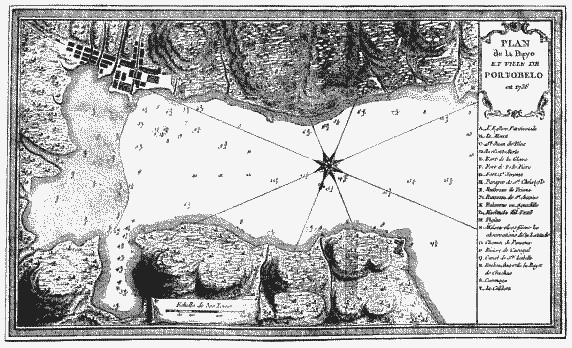
Exquemelin has left us a narrative
of this exploit which is more
circumstantial than any other we
possess, and agrees so closely with
what we know from other sources that
we must accept the author's
statement that he was an
eye-witness. He relates the whole
story, moreover, in so entertaining
and picturesque a manner that he
deserves quotation.
"Captain Morgan," he says, "who
knew very well all the avenues of
this city, as also all the
neighbouring coasts, arrived in the
dusk of the evening at the place
called Puerto de Naos, distant ten
leagues towards the west of Porto
Bello.269
Being come unto this place, they
mounted the river in their ships, as
far as another harbour called Puerto
Pontin, where they came to anchor.
Here they put themselves immediately
into boats and canoes, leaving in
the ships only a few men to keep
them and conduct them the next day unto
the port. About midnight they came
to a certain place called Estera
longa Lemos, where they all went on
shore, and marched by land to the
first posts of the city. They had in
their company a certain Englishman,
who had been formerly a prisoner in
those parts, and who now served them
for a guide. Unto him, and three or
four more, they gave commission to
take the sentry, if possible, or to
kill him upon the place. But they
laid hands on him and apprehended
him with such cunning as he had no
time to give warning with his
musket, or make any other noise.
Thus they brought him, with his
hands bound, unto Captain Morgan,
who asked him: 'How things went in
the city, and what forces they had';
with many other circumstances, which
he was desirous to know. After every
question they made him a thousand
menaces to kill him, in case he
declared not the truth. Thus they
began to advance towards the city,
carrying always the said sentry
bound before them. Having marched
about one quarter of a league, they
came to the castle that is nigh unto
the city, which presently they
closely surrounded, so that no
person could get either in or out of
the said fortress.
"Being thus posted under the
walls of the castle, Captain Morgan
commanded the sentry, whom they had
taken prisoner, to speak to those
that were within, charging them to
surrender, and deliver themselves up
to his discretion; otherwise they
should be all cut in pieces, without
giving quarter to any one. But they
would hearken to none of these
threats, beginning instantly to
fire; which gave notice unto the
city, and this was suddenly alarmed.
Yet, notwithstanding, although the
Governor and soldiers of the said
castle made as great resistance as
could be performed, they were
constrained to surrender unto the
Pirates. These no sooner had taken
the castle, than they resolved to be
as good as their words, in putting
the Spaniards to the sword,
thereby to strike a terror into the
rest of the city. Hereupon, having
shut up all the soldiers and
officers as prisoners into one room,
they instantly set fire to the
powder (whereof they found great
quantity), and blew up the whole
castle into the air, with all the
Spaniards that were within. This
being done, they pursued the course
of their victory, falling upon the
city, which as yet was not in order
to receive them. Many of the
inhabitants cast their precious
jewels and moneys into wells and
cisterns or hid them in other places
underground, to excuse, as much as
were possible, their being totally
robbed. One party of the Pirates
being assigned to this purpose, ran
immediately to the cloisters, and
took as many religious men and women
as they could find. The Governor of
the city not being able to rally the
citizens, through the huge confusion
of the town, retired unto one of the
castles remaining, and from thence
began to fire incessantly at the
Pirates. But these were not in the
least negligent either to assault
him or defend themselves with all
the courage imaginable. Thus it was
observed that, amidst the horror of
the assault, they made very few shot
in vain. For aiming with great
dexterity at the mouths of the guns,
the Spaniards were certain to lose
one or two men every time they
charged each gun anew.
"The assault of this castle where
the Governor was continued very
furious on both sides, from break of
day until noon. Yea, about this time
of the day the case was very dubious
which party should conquer or be
conquered. At last the Pirates,
perceiving they had lost many men
and as yet advanced but little
towards the gaining either this or
the other castles remaining, thought
to make use of fireballs, which they
threw with their hands, designing,
if possible, to burn the doors of
the castle. But going about to put
this in execution, the Spaniards
from the walls let fall great
quantity of stones and earthen pots
full of powder and other combustible
matter, which forced them to desist
from that attempt. Captain Morgan,
seeing this generous defence made by
the Spaniards, began to despair of
the whole success of the enterprise.
Hereupon many faint and calm
meditations came into his mind;
neither could he determine which way
to turn himself in that straitness
of affairs. Being involved in these
thoughts, he was suddenly animated
to continue the assault, by seeing
the English colours put forth at one
of the lesser castles, then entered
by his men, of whom he presently
after spied a troop that came to
meet him proclaiming victory with
loud shouts of joy. This instantly
put him upon new resolutions of
making new efforts to take the rest
of the castles that stood out
against him; especially seeing the
chief citizens were fled unto them,
and had conveyed thither great part
of their riches, with all the plate
belonging to the churches, and other
things dedicated to divine service.
"To this effect, therefore, he
ordered ten or twelve ladders to be
made, in all possible haste, so
broad that three or four men at once
might ascend by them. These being
finished, he commanded all the
religious men and women whom he had
taken prisoners to fix them against
the walls of the castle. Thus much
he had beforehand threatened the
Governor to perform, in case he
delivered not the castle. But his
answer was: 'He would never
surrender himself alive.' Captain
Morgan was much persuaded that the
Governor would not employ his utmost
forces, seeing religious women and
ecclesiastical persons exposed in
the front of the soldiers to the
greatest dangers. Thus the ladders,
as I have said, were put into the
hands of religious persons of both
sexes; and these were forced, at the
head of the companies, to raise and
apply them to the walls. But Captain
Morgan was deceived in his judgment
of this design. For the Governor,
who acted like a brave and
courageous soldier, refused not, in
performance of his duty, to use his
utmost endeavours to destroy
whosoever came near the walls. The
religious men and women ceased not
to cry unto him and beg of him by
all the Saints of Heaven he would
deliver the castle, and hereby spare
both his and their own lives. But
nothing could prevail with the
obstinacy and fierceness that had
possessed the Governor's mind. Thus
many of the religious men and nuns
were killed before they could fix
the ladders. Which at last being
done, though with great loss of the
said religious people, the Pirates
mounted them in great numbers, and
with no less valour; having
fireballs in their hands, and
earthen pots full of powder. All
which things, being now at the top
of the walls, they kindled and cast
in among the Spaniards.
"This effort of the Pirates was
very great, insomuch as the
Spaniards could no longer resist nor
defend the castle, which was now
entered. Hereupon they all threw
down their arms, and craved quarter
for their lives. Only the Governor
of the city would admit or crave no
mercy; but rather killed many of the
Pirates with his own hands, and not
a few of his own soldiers, because
they did not stand to their arms.
And although the Pirates asked him
if he would have quarter, yet he
constantly answered: 'By no means; I
had rather die as a valiant soldier,
than be hanged as a coward.' They
endeavoured as much as they could to
take him prisoner. But he defended
himself so obstinately that they
were forced to kill him;
notwithstanding all the cries and
tears of his own wife and daughter,
who begged of him upon their knees
he would demand quarter and save his
life. When the Pirates had possessed
themselves of the castle, which was
about night, they enclosed therein
all the prisoners they had taken,
placing the women and men by
themselves, with some guards upon
them. All the wounded were put into
a certain apartment by itself, to
the intent their own complaints might be the cure of
their diseases; for no other was
afforded them.
"This being done, they fell to
eating and drinking after their
usual manner; that is to say,
committing in both these things all
manner of debauchery and excess....
After such manner they delivered
themselves up unto all sort of
debauchery, that if there had been
found only fifty courageous men,
they might easily have re-taken the
city, and killed all the Pirates.
The next day, having plundered all
they could find, they began to
examine some of the prisoners (who
had been persuaded by their
companions to say they were the
richest of the town), charging them
severely to discover where they had
hidden their riches and goods. But
not being able to extort anything
out of them, as they were not the
right persons that possessed any
wealth, they at last resolved to
torture them. This they performed
with such cruelty that many of them
died upon the rack, or presently
after. Soon after, the President of
Panama had news brought him of the
pillage and ruin of Porto Bello.
This intelligence caused him to
employ all his care and industry to
raise forces, with design to pursue
and cast out the Pirates from
thence. But these cared little for
what extraordinary means the
President used, as having their
ships nigh at hand, and being
determined to set fire unto the city
and retreat. They had now been at
Porto Bello fifteen days, in which
space of time they had lost many of
their men, both by the unhealthiness
of the country and the extravagant
debaucheries they had committed.270
"Hereupon they prepared for a
departure, carrying on board their ships all
the pillage they had gotten. But,
before all, they provided the fleet
with sufficient victuals for the
voyage. While these things were
getting ready, Captain Morgan sent
an injunction unto the prisoners,
that they should pay him a ransom
for the city, or else he would by
fire consume it to ashes, and blow
up all the castles into the air.
Withal, he commanded them to send
speedily two persons to seek and
procure the sum he demanded, which
amounted to one hundred thousand
pieces of eight. Unto this effect,
two men were sent to the President
of Panama, who gave him an account
of all these tragedies. The
President, having now a body of men
in readiness, set forth immediately
towards Porto Bello, to encounter
the Pirates before their retreat.
But these people, hearing of his
coming, instead of flying away, went
out to meet him at a narrow passage
through which of necessity he ought
to pass. Here they placed an hundred
men very well armed; the which, at
the first encounter, put to flight a
good party of those of Panama. This
accident obliged the President to
retire for that time, as not being
yet in a posture of strength to
proceed any farther. Presently after
this rencounter he sent a message
unto Captain Morgan to tell him:
'That in case he departed not
suddenly with all his forces from
Porto Bello, he ought to expect no
quarter for himself nor his
companions, when he should take
them, as he hoped soon to do.'
Captain Morgan, who feared not his
threats knowing he had a secure
retreat in his ships which were nigh
at hand, made him answer: 'He would
not deliver the castles, before he
had received the contribution money
he had demanded. Which in case it
were not paid down, he would
certainly burn the whole city, and
then leave it, demolishing
beforehand the castles and killing
the prisoners.'
"The Governor of Panama perceived
by this answer that no means would
serve to mollify the hearts of the
Pirates, nor reduce them to reason.
Hereupon he determined to leave
them; as also those of the city,
whom he came to relieve, involved in
the difficulties of making the best
agreement they could with their
enemies.271
Thus, in a few days more, the
miserable citizens gathered the
contribution wherein they were
fined, and brought the entire sum of
one hundred thousand pieces of eight
unto the Pirates, for a ransom of
the cruel captivity they were fallen
into. But the President of Panama,
by these transactions, was brought
into an extreme admiration,
considering that four hundred men
had been able to take such a great
city, with so many strong castles;
especially seeing they had no pieces
of cannon, nor other great guns,
wherewith to raise batteries against
them. And what was more, knowing
that the citizens of Porto Bello had
always great repute of being good
soldiers themselves, and who had
never wanted courage in their own
defence. This astonishment was so
great, that it occasioned him, for
to be satisfied therein, to send a
messenger unto Captain Morgan,
desiring him to send him some small
pattern of those arms wherewith he
had taken with such violence so
great a city. Captain Morgan
received this messenger very kindly,
and treated him with great civility.
Which being done, he gave him a
pistol and a few small bullets of
lead, to carry back unto the
President, his Master, telling him
withal: 'He desired him to accept
that slender pattern of the arms
wherewith he had taken Porto Bello
and keep them for a twelvemonth;
after which time he promised to come
to Panama and fetch them away.' The
governor of Panama returned the
present very soon unto Captain
Morgan, giving him thanks for the
favour of lending him such weapons
as he needed not, and withal sent him a ring of gold,
with this message: 'That he desired
him not to give himself the labour
of coming to Panama, as he had done
to Porto Bello; for he did certify
unto him, he should not speed so
well here as he had done there.'
"After these transactions,
Captain Morgan (having provided his
fleet with all necessaries, and
taken with him the best guns of the
castles, nailing the rest which he
could not carry away) set sail from
Porto Bello with all his ships. With
these he arrived in a few days unto
the Island of Cuba, where he sought
out a place wherein with all quiet
and repose he might make the
dividend of the spoil they had
gotten. They found in ready money
two hundred and fifty thousand
pieces of eight, besides all other
merchandises, as cloth, linen, silks
and other goods. With this rich
purchase they sailed again from
thence unto their common place of
rendezvous, Jamaica. Being arrived,
they passed here some time in all
sorts of vices and debauchery,
according to their common manner of
doing, spending with huge
prodigality what others had gained
with no small labour and toil."272
Morgan and his officers, on their
return to Jamaica in the middle of
August, made an official report
which places their conduct in a
peculiarly mild and charitable
light,273
and forms a sharp contrast to the
account left us by Exquemelin.
According to Morgan the town and
castles were restored "in as good
condition as they found them," and
the people were so well treated that
"several ladies of great quality and
other prisoners" who were offered
"their liberty to go to the
President's camp, refused, saying
they were now prisoners to a person
of quality, who was more tender of
their honours than they doubted to
find in the president's camp, and so
voluntarily continued with them till
the surrender of the town and
castles." This scarcely tallies with
what we know of the manners of the
freebooters, and Exquemelin's
evidence is probably nearer the
truth. When Morgan returned to
Jamaica Modyford at first received
him somewhat doubtfully, for
Morgan's commission, as the Governor
told him, was only against ships,
and the Governor was not at all sure
how the exploit would be taken in
England. Morgan, however, had
reported that at Porto Bello, as
well as in Cuba, levies were being
made for an attack upon Jamaica, and
Modyford laid great stress upon this
point when he forwarded the
buccaneer's narrative to the Duke of
Albemarle.
The sack of Porto Bello was
nothing less than an act of open war
against Spain, and Modyford, now
that he had taken the decisive step,
was not satisfied with half
measures. Before the end of October
1668 the whole fleet of privateers,
ten sail and 800 men, had gone out
again under Morgan to cruise on the
coasts of Caracas, while Captain
Dempster with several other vessels
and 300 followers lay before
Havana and along the shores of
Campeache.274
Modyford had written home repeatedly
that if the king wished him to
exercise any adequate control over
the buccaneers, he must send from
England two or three nimble
fifth-rate frigates to command their
obedience and protect the island
from hostile attacks. Charles in
reply to these letters sent out the
"Oxford," a frigate of thirty-four
guns, which arrived at Port Royal on
14th October. According to Beeston's
Journal, it brought instructions
countenancing the war, and
empowering the governor to
commission whatever persons he
thought good to be partners with His
Majesty in the plunder, "they
finding victuals, wear and tear."275
The frigate was immediately
provisioned for a several months'
cruise, and sent under command of
Captain Edward Collier to join
Morgan's fleet as a private
ship-of-war. Morgan had appointed
the Isle la Vache, or Cow Island, on
the south side of Hispaniola, as the
rendezvous for the privateers; and
thither flocked great numbers, both
English and French, for the name of
Morgan was, by his exploit at Porto
Bello, rendered famous in all the
neighbouring islands. Here, too,
arrived the "Oxford" in December.
Among the French privateers were two
men-of-war, one of which, the "Cour
Volant" of La Rochelle, commanded by
M. la Vivon, was seized by Captain
Collier for having robbed an English
vessel of provisions. A few days
later, on 2nd January, a council of
war was held aboard the "Oxford,"
where it was decided that the
privateers, now numbering about 900
men, should attack Cartagena. While
the captains were at dinner on the
quarter-deck, however, the frigate
blew up, and about 200 men,
including five captains, were lost.276
"I was eating my dinner with the rest," writes the
surgeon, Richard Browne, "when the
mainmasts blew out, and fell upon
Captains Aylett, Bigford, and
others, and knocked them on the
head; I saved myself by getting
astride the mizzenmast." It seems
that out of the whole ship only
Morgan and those who sat on his side
of the table were saved. The
accident was probably caused by the
carelessness of a gunner. Captain
Collier sailed in la Vivon's ship
for Jamaica, where the French
captain was convicted of piracy in
the Admiralty Court, and reprieved
by Governor Modyford, but his ship
confiscated.277
Morgan, from the rendezvous at
the Isle la Vache, had coasted along
the southern shores of Hispaniola
and made several inroads upon the
island for the purpose of securing
beef and other provisions. Some of
his ships, meanwhile, had been
separated from the body of the
fleet, and at last he found himself
with but eight vessels and 400 or
500 men, scarcely more than half his
original company. With these small
numbers he changed his resolution to
attempt Cartagena, and set sail for
Maracaibo, a town situated on the
great lagoon of that name in
Venezuela. This town had been
pillaged in 1667, just before the
peace of Aix-la-Chapelle, by 650
buccaneers led by two French
captains, L'Olonnais and Michel le
Basque, and had suffered all the
horrors attendant upon such a visit.
In March 1669 Morgan appeared at the
entrance to the lake, forced the
passage after a day's hot
bombardment, dismantled the fort
which commanded it, and entered
Maracaibo, from which the
inhabitants had fled before him. The buccaneers sacked the
town, and scoured the woods in
search of the Spaniards and their
valuables. Men, women and children
were brought in and cruelly tortured
to make them confess where their
treasures were hid. Morgan, at the
end of three weeks, "having now got
by degrees into his hands about 100
of the chief families," resolved to
go to Gibraltar, near the head of
the lake, as L'Olonnais had done
before him. Here the scenes of
inhuman cruelty, "the tortures,
murders, robberies and such like
insolences," were repeated for five
weeks; after which the buccaneers,
gathering up their rich booty,
returned to Maracaibo, carrying with
them four hostages for the ransom of
the town and prisoners, which the
inhabitants promised to send after
them. At Maracaibo Morgan learnt
that three large Spanish men-of-war
were lying off the entrance of the
lake, and that the fort, in the
meantime, had been armed and manned
and put into a posture of defence.
In order to gain time he entered
into negotiations with the Spanish
admiral, Don Alonso del Campo y
Espinosa, while the privateers
carefully made ready a fireship
disguised as a man-of-war. At dawn
on 1st May 1669, according to
Exquemelin, they approached the
Spanish ships riding at anchor
within the entry of the lake, and
sending the fireship ahead of the
rest, steered directly for them. The
fireship fell foul of the
"Almirante," a vessel of forty guns,
grappled with her and set her in
flames. The second Spanish ship,
when the plight of the Admiral was
discovered, was run aground and
burnt by her own men. The third was
captured by the buccaneers. As no
quarter was given or taken, the loss
of the Spaniards must have been
considerable, although some of those
on the Admiral, including Don
Alonso, succeeded in reaching shore.
From a pilot picked up by the
buccaneers, Morgan learned that in
the flagship was a great quantity of
plate to the value of 40,000 pieces
of eight. Of this he succeeded in recovering about
half, much of it melted by the force
of the heat. Morgan then returned to
Maracaibo to refit his prize, and
opening negotiations again with Don
Alonso, he actually succeeded in
obtaining 20,000 pieces of eight and
500 head of cattle as a ransom for
the city. Permission to pass the
fort, however, the Spaniard refused.
So, having first made a division of
the spoil,278
Morgan resorted to an ingenious
stratagem to effect his egress from
the lake. He led the Spaniards to
believe that he was landing his men
for an attack on the fort from the
land side; and while the Spaniards
were moving their guns in that
direction, Morgan in the night, by
the light of the moon, let his ships
drop gently down with the tide till
they were abreast of the fort, and
then suddenly spreading sail made
good his escape. On 17th May the
buccaneers returned to Port Royal.
These events in the West Indies
filled the Spanish Court with
impotent rage, and the Conde de
Molina, ambassador in England, made
repeated demands for the punishment
of Modyford, and for the restitution
of the plate and other captured
goods which were beginning to flow
into England from Jamaica. The
English Council replied that the
treaty of 1667 was not understood to
include the Indies, and Charles II.
sent him a long list of complaints
of ill-usage to English ships at the
hands of the Spaniards in America.279
Orders seem to have been sent to
Modyford, however, to stop
hostilities, for in May 1669
Modyford again called in all
commissions,280
and Beeston writes in his Journal,
under 14th June, that peace was
publicly proclaimed with the
Spaniards. In November, moreover, the governor
told Albemarle that most of the
buccaneers were turning to trade,
hunting or planting, and that he
hoped soon to reduce all to peaceful
pursuits.281
The Spanish Council of State, in the
meantime, had determined upon a
course of active reprisal. A
commission from the queen-regent,
dated 20th April 1669, commanded her
governors in the Indies to make open
war against the English;282
and a fleet of six vessels, carrying
from eighteen to forty-eight guns,
was sent from Spain to cruise
against the buccaneers. To this
fleet belonged the three ships which
tried to bottle up Morgan in Lake
Maracaibo. Port Royal was filled
with report and rumour of English
ships captured and plundered, of
cruelties to English prisoners in
the dungeons of Cartagena, of
commissions of war issued at Porto
Bello and St. Jago de Cuba, and of
intended reprisals upon the
settlements in Jamaica. The
privateers became restless and spoke
darkly of revenge, while Modyford,
his old supporter the Duke of
Albemarle having just died, wrote
home begging for orders which would
give him liberty to retaliate.283
The last straw fell in June 1670,
when two Spanish men-of-war from St.
Jago de Cuba, commanded by a
Portuguese, Manuel Rivero Pardal,
landed men on the north side of the
island, burnt some houses and
carried off a number of the
inhabitants as prisoners.284
On 2nd July the governor and council
issued a commission to Henry Morgan,
as commander-in-chief of
all ships of war belonging to
Jamaica, to get together the
privateers for the defence of the
island, to attack, seize and destroy
all the enemy's vessels he could
discover, and in case he found it
feasible, "to land and attack St.
Jago or any other place where ...
are stores for this war or a
rendezvous for their forces." In the
accompanying instructions he was
bidden "to advise his fleet and
soldiers that they were upon the old
pleasing account of no purchase, no
pay, and therefore that all which is
got, shall be divided amongst them,
according to the accustomed rules."285
Morgan sailed from Jamaica on
14th August 1670 with eleven vessels
and 600 men for the Isle la Vache,
the usual rendezvous, whence during
the next three months squadrons were
detailed to the coast of Cuba and
the mainland of South America to
collect provisions and intelligence.
Sir William Godolphin was at that
moment in Madrid concluding articles
for the establishment of peace and
friendship in America; and on 12th
June Secretary Arlington wrote to
Modyford that in view of these
negotiations his Majesty commanded
the privateers to forbear all
hostilities on land against the
Spaniards.286
These orders reached Jamaica on 13th
August, whereupon the governor
recalled Morgan, who had sailed from
the harbour the day before, and
communicated them to him, "strictly
charging him to observe the same and
behave with all moderation possible
in carrying on the war." The admiral
replied that necessity would compel
him to land in the Spaniards'
country for wood, water and
provisions, but unless he was
assured that the enemy in their
towns were making hostile
preparations against the Jamaicans,
he would not touch any of them.287
On 6th September, however,
Vice-Admiral Collier with six sail and 400 men was
dispatched by Morgan to the Spanish
Main. There on 4th November he
seized, in the harbour of Santa
Marta, two frigates laden with
provisions for Maracaibo. Then
coasting eastward to Rio de la
Hacha, he attacked and captured the
fort with its commander and all its
garrison, sacked the city, held it
to ransom for salt, maize, meat and
other provisions, and after
occupying it for almost a month
returned on 28th October to the Isle
la Vache.288
One of the frigates captured at
Santa Marta, "La Gallardina," had
been with Pardal when he burnt the
coast of Jamaica. Pardal's own ship
of fourteen guns had been captured
but a short time before by Captain
John Morris at the east end of Cuba,
and Pardal himself shot through the
neck and killed.289
He was called by the Jamaicans "the
vapouring admiral of St. Jago," for
in June he had nailed a piece of
canvas to a tree on the Jamaican
coast, with a curious challenge
written both in English and
Spanish:—
"I, Captain Manuel Rivero Pardal,
to the chief of the squadron of
privateers in Jamaica. I am he who
this year have done that which
follows. I went on shore at
Caimanos, and burnt 20 houses, and
fought with Captain Ary, and took
from him a catch laden with
provisions and a canoe. And I am he
who took Captain Baines and did
carry the prize to Cartagena, and
now am arrived to this coast, and
have burnt it. And I come to seek
General Morgan, with 2 ships of 20
guns, and having seen this, I crave
he would come out upon the coast and
seek me, that he might see the
valour of the Spaniards. And because
I had no time I did not come to the
mouth of Port Royal to speak by word
of mouth in the name of my king,
whom God preserve. Dated the 5th of
July 1670."290
Meanwhile, in the middle of
October, there sailed into Port
Royal three privateers, Captains
Prince, Harrison and Ludbury, who
six weeks before had ascended the
river San Juan in Nicaragua with 170
men and again plundered the
unfortunate city of Granada. The
town had rapidly decayed, however,
under the repeated assaults of the
buccaneers, and the plunderers
secured only £20 or £30 per man.
Modyford reproved the captains for
acting without commissions, but "not
deeming it prudent to press the
matter too far in this juncture,"
commanded them to join Morgan at the
Isle la Vache.291
There Morgan was slowly mustering
his strength. He negotiated with the
French of Tortuga and Hispaniola who
were then in revolt against the
régime of the French Company;
and he added to his forces seven
ships and 400 men sent him by the
indefatigable Governor of Jamaica.
On 7th October, indeed, the venture
was almost ruined by a violent storm
which cast the whole fleet, except
the Admiral's vessel, upon the
shore. All of the ships but three,
however, were eventually got off and
repaired, and on 6th December Morgan
was able to write to Modyford that
he had 1800 buccaneers, including
several hundred French, and
thirty-six ships under his command.292
Upon consideration of the reports
brought from the Main by his own
men, and the testimony of prisoners
they had taken, Morgan decided that
it was impossible to attempt what
seems to have been his original
design, a descent upon St. Jago de
Cuba, without great loss of
men and ships. On 2nd December,
therefore, it was unanimously agreed
by a general council of all the
captains, thirty-seven in number,
"that it stands most for the good of
Jamaica and safety of us all to take
Panama, the President thereof having
granted several commissions against
the English."293
Six days later the fleet put to sea
from Cape Tiburon, and on the
morning of the 14th sighted
Providence Island. The Spanish
governor capitulated next day, on
condition of being transported with
his garrison to the mainland, and
four of his soldiers who had
formerly been banditti in the
province of Darien agreed to become
guides for the English.294
After a delay of five days more,
Lieutenant-Colonel Joseph Bradley, with
between 400 and 500 men in three
ships, was sent ahead by Morgan to
the isthmus to seize the Castle of
San Lorenzo, situated at the mouth
of the Chagre river.

The President of Panama,
meanwhile, on 15th December, had
received a messenger from the
governor of Cartagena with news of
the coming of the English.295
The president immediately dispatched
reinforcements to the Castle of
Chagre, which arrived fifteen days
before the buccaneers and raised its
strength to over 350 men. Two
hundred men were sent to Porto
Bello, and 500 more were stationed
at Venta Cruz and in ambuscades
along the Chagre river to oppose the
advance of the English. The
president himself rose from a bed of
sickness to head a reserve of 800,
but most of his men were raw
recruits without a professional
soldier amongst them. This militia
in a few days became so
panic-stricken that one-third
deserted in a night, and the
president was compelled to retire to
Panama. There the Spaniards managed
to load some of the treasure upon
two or three ships lying in the
roadstead; and the nuns and most of
the citizens of importance also
embarked with their wives, children
and personal property.296
The fort or castle of San
Lorenzo, which stood on a hill
commanding the river Chagre, seems
to have been built of double rows of
wooden palisades, the space between
being filled with earth; and it was
protected by a ditch 12 feet deep
and by several smaller batteries
nearer the water's edge.
Lieutenant-Colonel Bradley, who,
according to Exquemelin, had been on
these coasts before with Captain
Mansfield, landed near the fort on
the 27th of December. He and his men
fought in the trenches from early
afternoon till eight o'clock next
morning, when they stormed and carried the
place. The buccaneers suffered
severely, losing about 150 in killed
and wounded, including Bradley
himself who died ten days later.
Exquemelin gives a very vivid
account of the action. The
buccaneers, he writes, "came to
anchor in a small port, at the
distance of a league more or less
from the castle. The next morning
very early they went on shore, and
marched through the woods, to attack
the castle on that side. This march
continued until two o'clock,
afternoon, by reason of the
difficulties of the way, and its
mire and dirt. And although their
guides served them exactly,
notwithstanding they came so nigh
the castle at first that they lost
many of their men with the shot from
the guns, they being in an open
place where nothing could cover nor
defend them. This much perplexed the
Pirates ..." (but) "at last after
many doubts and disputes among
themselves they resolved to hazard
the assault and their lives after a
most desperate manner. Thus they
advanced towards the castle, with
their swords in one hand and
fireballs in the other. The
Spaniards defended themselves very
briskly, ceasing not to fire at them
with their great guns and muskets
continually crying withal: 'Come on,
ye English dogs, enemies to God and
our King; let your other companions
that are behind come on too, ye
shall not go to Panama this bout.'
After the Pirates had made some
trial to climb up the walls, they
were forced to retreat, which they
accordingly did, resting themselves
until night. This being done, they
returned to the assault, to try if
by the help of their fireballs they
could overcome and pull down the
pales before the wall. This they
attempted to do, and while they were
about it there happened a very
remarkable accident, which gave them
the opportunity of the victory. One
of the Pirates was wounded with an
arrow in his back, which pierced his
body to the other side. This he
instantly pulled out with great
valour at the side of his breast;
then taking a little cotton that he had about him,
he wound it about the said arrow,
and putting it into his musket, he
shot it back into the castle. But
the cotton being kindled by the
powder, occasioned two or three
houses that were within the castle,
being thatched with palm-leaves, to
take fire, which the Spaniards
perceived not so soon as was
necessary. For this fire meeting
with a parcel of powder, blew it up
and thereby caused great ruin, and
no less consternation to the
Spaniards, who were not able to
account for this accident, not
having seen the beginning thereof.
"Thus the Pirates perceiving the
good effect of the arrow and the
beginning of the misfortune of the
Spaniards, were infinitely gladdened
thereat. And while they were busied
in extinguishing the fire, which
caused great confusion in the whole
castle, having not sufficient water
wherewithal to do it, the Pirates
made use of this opportunity,
setting fire likewise to the
palisades. Thus the fire was seen at
the same time in several parts about
the castle, which gave them huge
advantage against the Spaniards. For
many breaches were made at once by
the fire among the pales, great
heaps of earth falling down into the
ditch. Upon these the Pirates
climbed up, and got over into the
castle, notwithstanding that some
Spaniards, who were not busied about
the fire, cast down upon them many
flaming pots, full of combustible
matter and odious smells, which
occasioned the loss of many of the
English.
"The Spaniards, notwithstanding
the great resistance they made,
could not hinder the palisades from
being entirely burnt before
midnight. Meanwhile the Pirates
ceased not to persist in their
intention of taking the castle. Unto
which effect, although the fire was
great, they would creep upon the
ground, as nigh unto it as they
could, and shoot amidst the flames,
against the Spaniards they could
perceive on the other side, and thus
cause many to fall dead from the
walls. When day was come, they
observed all the moveable earth
that lay between the pales to be
fallen into the ditch in huge
quantity. So that now those within
the castle did in a manner lie
equally exposed to them without, as
had been on the contrary before.
Whereupon the Pirates continued
shooting very furiously against
them, and killed great numbers of
Spaniards. For the Governor had
given them orders not to retire from
those posts which corresponded to
the heaps of earth fallen into the
ditch, and caused the artillery to
be transported unto the breaches.
"Notwithstanding, the fire within
the castle still continued, and now
the Pirates from abroad used what
means they could to hinder its
progress, by shooting incessantly
against it. One party of the Pirates
was employed only to this purpose,
and another commanded to watch all
the motions of the Spaniards, and
take all opportunities against them.
About noon the English happened to
gain a breach, which the Governor
himself defended with twenty-five
soldiers. Here was performed a very
courageous and warlike resistance by
the Spaniards, both with muskets,
pikes, stones and swords. Yet
notwithstanding, through all these
arms the Pirates forced and fought
their way, till at last they gained
the castle. The Spaniards who
remained alive cast themselves down
from the castle into the sea,
choosing rather to die precipitated
by their own selves (few or none
surviving the fall) than to ask any
quarter for their lives. The
Governor himself retreated unto the
corps du garde, before which were
placed two pieces of cannon. Here he
intended still to defend himself,
neither would he demand any quarter.
But at last he was killed with a
musket shot, which pierced his skull
into the brain.
"The Governor being dead, and the
corps du garde surrendered, they
found still remaining in it alive to
the number of thirty men, whereof
scarce ten were not wounded. These
informed the Pirates that eight or
nine of their soldiers had
deserted their colours, and were
gone to Panama to carry news of
their arrival and invasion. These
thirty men alone were remaining of
three hundred and fourteen,
wherewith the castle was garrisoned,
among which number not one officer
was found alive. These were all made
prisoners, and compelled to tell
whatsoever they knew of their
designs and enterprises."297
Five days after the taking of the
castle, Morgan arrived from
Providence Island with the rest of
the armament; but at the entrance to
the Chagre river, in passing over
the bar, his flagship and five or
six smaller boats were wrecked, and
ten men were drowned. After
repairing and provisioning the
castle, and leaving 300 men to guard
it and the ships, Morgan, on 9th
January 1671, at the head of 1400
men, began the ascent of the river
in seven small vessels and
thirty-six canoes.298
The story of this brilliant march we
will again leave to Exquemelin, who
took part in it, to relate. The
first day "they sailed only six
leagues, and came to a place called
De los Bracos. Here a party of his
men went on shore, only to sleep
some few hours and stretch their
limbs, they being almost crippled
with lying too much crowded in the
boats. After they had rested awhile,
they went abroad, to see if any
victuals could be found in the
neighbouring plantations. But they
could find none, the Spaniards being
fled and carrying with them all the
provisions they had. This day, being
the first of their journey, there
was amongst them such scarcity of
victuals that the greatest part were
forced to pass with only a pipe of
tobacco, without any other
refreshment.
"The next day, very early in the
morning, they continued their
journey, and came about evening to a
place called Cruz de Juan
Gallego. Here they were compelled to
leave their boats and canoes, by
reason the river was very dry for
want of rain, and the many obstacles
of trees that were fallen into it.
The guides told them that about two
leagues farther on the country would
be very good to continue the journey
by land. Hereupon they left some
companies, being in all one hundred
and sixty men,299
on board the boats to defend them,
with intent they might serve for a
place of refuge in case of
necessity.
"The next morning, being the
third day of their journey, they all
went ashore, excepting those
above-mentioned who were to keep the
boats. Unto these Captain Morgan
gave very strict orders, under great
penalties, that no man, upon any
pretext whatsoever, should dare to
leave the boats and go ashore. This
he did, fearing lest they should be
surprised and cut off by an
ambuscade of Spaniards, that might
chance to lie thereabouts in the
neighbouring woods, which appeared
so thick as to seem almost
impenetrable. Having this morning
begun their march, they found the
ways so dirty and irksome, that
Captain Morgan thought it more
convenient to transport some of the
men in canoes (though it could not
be done without great labour) to a
place farther up the river, called
Cedro Bueno. Thus they re-embarked,
and the canoes returned for the rest
that were left behind. So that about
night they found themselves all
together at the said place. The
Pirates were extremely desirous to
meet any Spaniards, or Indians,
hoping to fill their bellies with
what provisions they should take
from them. For now they were reduced
almost to the very extremity of
hunger.
"On the fourth day, the greatest
part of the Pirates marched by land,
being led by one of the guides. The
rest went by water, farther up with
the canoes, being conducted by another guide, who
always went before them with two of
the said canoes, to discover on both
sides the river the ambuscades of
the Spaniards. These had also spies,
who were very dextrous, and could at
any time give notice of all
accidents or of the arrival of the
Pirates, six hours at least before
they came to any place. This day
about noon they found themselves
nigh unto a post, called Torna
Cavallos. Here the guide of the
canoes began to cry aloud he
perceived an ambuscade. His voice
caused infinite joy unto all the
Pirates, as persuading themselves
they should find some provisions
wherewith to satiate their hunger,
which was very great. Being come
unto the place, they found nobody in
it, the Spaniards who were there not
long before being every one fled,
and leaving nothing behind unless it
were a small number of leather bags,
all empty, and a few crumbs of bread
scattered upon the ground where they
had eaten.300
Being angry at this misfortune, they
pulled down a few little huts which
the Spaniards had made, and
afterwards fell to eating the
leathern bags, as being desirous to
afford something to the ferment of
their stomachs, which now was grown
so sharp that it did gnaw their very
bowels, having nothing else to prey
upon. Thus they made a huge banquet
upon those bags of leather, which
doubtless had been more grateful
unto them, if divers quarrels had
not risen concerning who should have
the greatest share. By the
circumference of the place they
conjectured five hundred Spaniards,
more or less, had been there. And
these, finding no victuals, they
were now infinitely desirous to
meet, intending to devour some of
them rather than perish. Whom they
would certainly in that occasion
have roasted or boiled, to satisfy
their famine, had they been able to
take them.
"After they had feasted
themselves with those pieces of
leather, they quitted the place, and
marched farther on, till they came
about night to another post called
Torna Munni. Here they found another
ambuscade, but as barren and desert
as the former. They searched the
neighbouring woods, but could not
find the least thing to eat. The
Spaniards having been so provident
as not to leave behind them anywhere
the least crumb of sustenance,
whereby the Pirates were now brought
to the extremity aforementioned.
Here again he was happy, that had
reserved since noon any small piece
of leather whereof to make his
supper, drinking after it a good
draught of water for his greatest
comfort. Some persons who never were
out of their mothers' kitchens may
ask how these Pirates could eat,
swallow and digest those pieces of
leather, so hard and dry. Unto whom
I only answer: That could they once
experiment what hunger, or rather
famine, is, they would certainly
find the manner, by their own
necessity, as the Pirates did. For
these first took the leather, and
sliced it in pieces. Then did they
beat it between two stones and rub
it, often dipping it in the water of
the river, to render it by these
means supple and tender. Lastly they
scraped off the hair, and roasted or
broiled it upon the fire. And being
thus cooked they cut it into small
morsels, and eat it, helping it down
with frequent gulps of water, which
by good fortune they had nigh at
hand.
"They continued their march the
fifth day, and about noon came unto
a place called Barbacoa. Here
likewise they found traces of
another ambuscade, but the place
totally as unprovided as the two
precedent were. At a small distance
were to be seen several plantations,
which they searched very narrowly,
but could not find any person, animal or other
thing that was capable of relieving
their extreme and ravenous hunger.
Finally, having ranged up and down
and searched a long time, they found
a certain grotto which seemed to be
but lately hewn out of a rock, in
which they found two sacks of meal,
wheat and like things, with two
great jars of wine, and certain
fruits called Platanos. Captain
Morgan, knowing that some of his men
were now, through hunger, reduced
almost to the extremity of their
lives, and fearing lest the major
part should be brought into the same
condition, caused all that was found
to be distributed amongst them who
were in greatest necessity. Having
refreshed themselves with these
victuals, they began to march anew
with greater courage than ever. Such
as could not well go for weakness
were put into the canoes, and those
commanded to land that were in them
before. Thus they prosecuted their
journey till late at night, at which
time they came unto a plantation
where they took up their rest. But
without eating anything at all; for
the Spaniards, as before, had swept
away all manner of provisions,
leaving not behind them the least
signs of victuals.
"On the sixth day they continued
their march, part of them by land
through the woods, and part by water
in the canoes. Howbeit they were
constrained to rest themselves very
frequently by the way, both for the
ruggedness thereof and the extreme
weakness they were under. Unto this
they endeavoured to occur, by eating
some leaves of trees and green
herbs, or grass, such as they could
pick, for such was the miserable
condition they were in. This day, at
noon, they arrived at a plantation,
where they found a barn full of
maize. Immediately they beat down
the doors, and fell to eating of it
dry, as much as they could devour.
Afterwards they distributed great
quantity, giving to every man a good
allowance thereof. Being thus
provided they prosecuted their
journey, which having continued for the space of an
hour or thereabouts, they met with
an ambuscade of Indians. This they
no sooner had discovered, but they
threw away their maize, with the
sudden hopes they conceived of
finding all things in abundance. But
after all this haste, they found
themselves much deceived, they
meeting neither Indians nor
victuals, nor anything else of what
they had imagined. They saw
notwithstanding on the other side of
the river a troop of a hundred
Indians more or less, who all
escaped away through the agility of
their feet. Some few Pirates there
were who leapt into the river, the
sooner to reach the shore to see if
they could take any of the said
Indians prisoners. But all was in
vain; for being much more nimble on
their feet than the Pirates they
easily baffled their endeavours.
Neither did they only baffle them,
but killed also two or three of the
Pirates with their arrows, shooting
at them at a distance, and crying:
'Ha! perros, a la savana, a la
savana. Ha! ye dogs, go to the
plain, go to the plain.'
"This day they could advance no
further, by reason they were
necessitated to pass the river
hereabouts to continue their march
on the other side. Hereupon they
took up their repose for that night.
Howbeit their sleep was not heavy
nor profound, for great murmurings
were heard that night in the camp,
many complaining of Captain Morgan
and his conduct in that enterprise,
and being desirous to return home.
On the contrary, others would rather
die there than go back one step from
what they had undertaken. But others
who had greater courage than any of
these two parties did laugh and joke
at all their discourses. In the
meanwhile they had a guide who much
comforted them, saying: 'It would
not now be long before they met with
people, from whom they should reap
some considerable advantage.'
"The seventh day in the morning
they all made clean their arms, and
every one discharged his pistol or
musket without bullet, to
examine the security of their
firelocks. This being done, they
passed to the other side of the
river in the canoes, leaving the
post where they had rested the night
before, called Santa Cruz. Thus they
proceeded on their journey till
noon, at which time they arrived at
a village called Cruz.301
Being at a great distance as yet
from the place, they perceived much
smoke to arise out of the chimneys.
The sight hereof afforded them great
joy and hopes of finding people in
the town, and afterwards what they
most desired, which was plenty of
good cheer. Thus they went on with
as much haste as they could, making
several arguments to one another
upon those external signs, though
all like castles built in the air.
'For,' said they, 'there is smoke
coming out of every house, and
therefore they are making good fires
to roast and boil what we are to
eat.' With other things to this
purpose.
"At length they arrived there in
great haste, all sweating and
panting, but found no person in the
town, nor anything that was eatable
wherewith to refresh themselves,
unless it were good fires to warm
themselves, which they wanted not.
For the Spaniards before their
departure, had every one set fire to
his own house, excepting only the
storehouses and stables belonging to
the King.
"They had not left behind them
any beast whatsoever, either alive
or dead. This occasioned much
confusion in their minds, they not
finding the least thing to lay hold
on, unless it were some few cats and
dogs, which they immediately killed
and devoured with great appetite. At
last in the King's stables they
found by good fortune fifteen or
sixteen jars of Peru wine, and a
leather sack full of bread. But no sooner
had they begun to drink of the said
wine when they fell sick, almost
every man. This sudden disaster made
them think that the wine was
poisoned, which caused a new
consternation in the whole camp, as
judging themselves now to be
irrecoverably lost. But the true
reason was, their huge want of
sustenance in that whole voyage, and
the manifold sorts of trash which
they had eaten upon that occasion.
Their sickness was so great that day
as caused them to remain there till
the next morning, without being able
to prosecute their journey as they
used to do, in the afternoon. This
village is seated in the latitude in
9 degrees and 2 minutes, northern
latitude, being distant from the
river of Chagre twenty-six Spanish
leagues, and eight from Panama.
Moreover, this is the last place
unto which boats or canoes can come;
for which reason they built here
store-houses, wherein to keep all
sorts of merchandise, which from
hence to and from Panama are
transported upon the backs of mules.
"Here therefore Captain Morgan
was constrained to leave his canoes
and land all his men, though never
so weak in their bodies. But lest
the canoes should be surprised, or
take up too many men for their
defence, he resolved to send them
all back to the place where the
boats were, excepting one, which he
caused to be hidden, to the intent
it might serve to carry intelligence
according to the exigency of
affairs. Many of the Spaniards and
Indians belonging to this village
were fled to the plantations
thereabouts. Hereupon Captain Morgan
gave express orders that none should
dare to go out of the village,
except in whole companies of a
hundred together. The occasion
hereof was his fear lest the enemy
should take an advantage upon his
men, by any sudden assault.
Notwithstanding, one party of
English soldiers stickled not to
contravene these commands, being
thereunto tempted with the desire
of finding victuals. But these were
soon glad to fly into the town
again, being assaulted with great
fury by some Spaniards and Indians,
who snatched up one of the Pirates,
and carried him away prisoner. Thus
the vigilance and care of Captain
Morgan was not sufficient to prevent
every accident that might happen.
"On the eighth day, in the
morning, Captain Morgan sent two
hundred men before the body of his
army, to discover the way to Panama,
and see if they had laid any
ambuscades therein. Especially
considering that the places by which
they were to pass were very fit for
that purpose, the paths being so
narrow that only ten or twelve
persons could march in a file, and
oftentimes not so many. Having
marched about the space of ten
hours, they came unto a place called
Quebrada Obscura. Here, all on a
sudden, three or four thousand
arrows were shot at them, without
being able to perceive from whence
they came, or who shot them. The
place, from whence it was presumed
they were shot was a high rocky
mountain, excavated from one side to
the other, wherein was a grotto that
went through it, only capable of
admitting one horse, or other beast
laden. This multitude of arrows
caused a huge alarm among the
Pirates, especially because they
could not discover the place from
whence they were discharged. At
last, seeing no more arrows to
appear, they marched a little
farther, and entered into a wood.
Here they perceived some Indians to
fly as fast as they could possible
before them, to take the advantage
of another post, and thence observe
the march of the Pirates. There
remained, notwithstanding one troop
of Indians upon the place, with full
design to fight and defend
themselves. This combat they
performed with huge courage, till
such time as their captain fell to
the ground wounded, who although he
was now in despair of life, yet his
valour being greater than his strength, would demand
no quarter, but, endeavouring to
raise himself, with undaunted mind
laid hold of his azagaya, or
javelin, and struck at one of the
Pirates. But before he could second
the blow, he was shot to death with
a pistol. This was also the fate of
many of his companions, who like
good and courageous soldiers lost
their lives with their captain, for
the defence of their country.
"The Pirates endeavoured, as much
as was possible, to lay hold on some
of the Indians and take them
prisoners. But they being infinitely
swifter than the Pirates, every one
escaped, leaving eight Pirates dead
upon the place and ten wounded.302
Yea, had the Indians been more
dextrous in military affairs, they
might have defended that passage,
and not let one sole man to pass.
Within a little while after they
came to a large campaign field open
and full of variegated meadows. From
here they could perceive at a
distance before them a parcel of
Indians who stood on the top of a
mountain, very nigh unto the way by
which the Pirates were to pass. They
sent a troop of fifty men, the
nimblest they could pick out, to see
if they could catch any of them, and
afterwards force them to declare
whereabouts their companions had
their mansions. But all their
industry was in vain, for they
escaped through their nimbleness,
and presently after showed
themselves in another place,
hallooing unto the English, and
crying: 'A la savana, a la savana,
cornudos, perros Ingleses;' that is,
'To the plain, to the plain, ye
cockolds, ye English dogs!' While
these things passed, the ten Pirates
that were wounded a little before
were dressed and plastered up.
"At this place there was a wood
and on each side thereof a mountain.
The Indians had possessed themselves
of the one, and the Pirates took
possession of the other that was
opposite unto it. Captain Morgan was
persuaded that in the wood the
Spaniards had placed an ambuscade,
as lying so conveniently for that
purpose. Hereupon he sent before two
hundred men to search it. The
Spaniards and Indians, perceiving
the Pirates to descend the mountain,
did so too, as if they designed to
attack them. But being got into the
wood, out of sight of the Pirates,
they disappeared, and were seen no
more, leaving the passage open unto
them.
"About night there fell a great
rain, which caused the Pirates to
march the faster and seek everywhere
for houses wherein to preserve their
arms from being wet. But the Indians
had set fire to every one
thereabouts, and transported all
their cattle unto remote places, to
the end that the Pirates, finding
neither houses nor victuals, might
be constrained to return homewards.
Notwithstanding, after diligent
search, they found a few little huts
belonging to shepherds, but in them
nothing to eat. These not being
capable of holding many men, they
placed in them out of every company
a small number, who kept the arms of
the rest of the army. Those who
remained in the open field endured
much hardship that night, the rain
not ceasing to fall until the
morning.
"The next morning, about break of
day, being the ninth of this tedious
journey, Captain Morgan continued
his march while the fresh air of the
morning lasted. For the clouds then
hanging as yet over their heads were
much more favourable unto them than
the scorching rays of the sun, by
reason the way was now more
difficult and laborious than all the
precedent. After two hours' march,
they discovered a troop of about
twenty Spaniards. who observed the
motions of the Pirates. They
endeavoured to catch some of them,
but could lay hold on none, they
suddenly disappearing, and
absconding themselves in caves among
the rocks, totally unknown to the
Pirates. At last they came to a high
mountain, which, when they ascended,
they discovered from the top thereof
the South Sea. This happy sight, as
if it were the end of their labours,
caused infinite joy among the
Pirates. From hence they could
descry also one ship and six boats,
which were set forth from Panama,
and sailed towards the islands of
Tavoga and Tavogilla. Having
descended this mountain, they came
unto a vale, in which they found
great quantity of cattle, whereof
they killed good store. Here while
some were employed in killing and
flaying of cows, horses, bulls and
chiefly asses, of which there was
greatest number, others busied
themselves in kindling of fires and
getting wood wherewith to roast
them. Thus cutting the flesh of
these animals into convenient
pieces, or gobbets, they threw them
into the fire and, half carbonadoed
or roasted, they devoured them with
incredible haste and appetite. For
such was their hunger that they more
resembled cannibals than Europeans
at this banquet, the blood many
times running down from their beards
to the middle of their bodies.
"Having satisfied their hunger
with these delicious meats, Captain
Morgan ordered them to continue the
march. Here again he sent before the
main body fifty men, with intent to
take some prisoners, if possibly
they could. For he seemed now to be
much concerned that in nine days'
time he could not meet one person
who might inform him of the
condition and forces of the
Spaniards. About evening they
discovered a troop of two hundred
Spaniards, more or less, who
hallooed unto the Pirates, but these
could not understand what they said.
A little while after they came the
first time within sight of the
highest steeple of Panama. This
steeple they no sooner had discovered but they
began to show signs of extreme joy,
casting up their hats into the air,
leaping for mirth, and shouting,
even just as if they had already
obtained the victory and entire
accomplishment of their designs. All
their trumpets were sounded and
every drum beaten, in token of this
universal acclamation and huge
alacrity of their minds. Thus they
pitched their camp for that night
with general content of the whole
army, waiting with impatience for
the morning, at which time they
intended to attack the city. This
evening there appeared fifty horse
who came out of the city, hearing
the noise of the drums and trumpets
of the Pirates, to observe, as it
was thought, their motions. They
came almost within musket-shot of
the army, being preceded by a
trumpet that sounded marvellously
well. Those on horseback hallooed
aloud unto the Pirates, and
threatened them, saying, 'Perros!
nos veremos,' that is, 'Ye dogs! we
shall meet ye.' Having made this
menace they returned to the city,
excepting only seven or eight
horsemen who remained hovering
thereabouts, to watch what motions
the Pirates made. Immediately after,
the city began to fire and ceased
not to play with their biggest guns
all night long against the camp, but
with little or no harm unto the
Pirates, whom they could not
conveniently reach. About this time
also the two hundred Spaniards whom
the Pirates had seen in the
afternoon appeared again within
sight, making resemblance as if they
would block up the passages, to the
intent no Pirates might escape the
hands of their forces. But the
Pirates, who were now in a manner
besieged, instead of conceiving any
fear of their blockades, as soon as
they had placed sentries about their
camp, began every one to open their
satchels, and without any
preparation of napkins or plates,
fell to eating very heartily the
remaining pieces of bulls' and
horses' flesh which they had
reserved since noon. This being
done, they laid themselves down to
sleep upon the grass with great
repose and huge satisfaction,
expecting only with impatience for
the dawnings of the next day.
"On the tenth day, betimes in the
morning, they put all their men in
convenient order, and with drums and
trumpets sounding, continued their
march directly towards the city. But
one of the guides desired Captain
Morgan not to take the common
highway that led thither, fearing
lest they should find in it much
resistance and many ambuscades. He
presently took his advice, and chose
another way that went through the
wood, although very irksome and
difficult. Thus the Spaniards,
perceiving the Pirates had taken
another way, which they scarce had
thought on or believed, were
compelled to leave their stops and
batteries, and come out to meet
them. The Governor of Panama put his
forces in order, consisting of two
squadrons, four regiments of foot,
and a huge number of wild bulls,
which were driven by a great number
of Indians, with some negroes and
others to help them.
"The Pirates being now upon their
march, came unto the top of a little
hill, from whence they had a large
prospect of the city and campaign
country underneath. Here they
discovered the forces of the people
of Panama, extended in battle array,
which, when they perceived to be so
numerous, they were suddenly
surprised with great fear, much
doubting the fortune of the day.
Yea, few or none there were but
wished themselves at home, or at
least free from the obligation of
that engagement, wherein they
perceived their lives must be so
narrowly concerned. Having been some
time at a stand, in a wavering
condition of mind, they at last
reflected upon the straits they had
brought themselves into, and that
now they ought of necessity either
to fight resolutely or die, for no
quarter could be expected from an
enemy against whom they had
committed so many cruelties on all
occasions. Hereupon they encouraged
one another, and resolved either to conquer, or spend the
very last drop of blood in their
bodies. Afterwards they divided
themselves into three battalions, or
troops, sending before them one of
two hundred buccaneers, which sort
of people are infinitely dextrous at
shooting with guns.303
Thus the Pirates left the hill and
descended, marching directly towards
the Spaniards, who were posted in a
spacious field, waiting for their
coming. As soon as they drew nigh
unto them, the Spaniards began to
shout and cry, 'Viva el Rey! God
save the King!' and immediately
their horse began to move against
the Pirates. But the field being
full of quags and very soft under
foot, they could not ply to and fro
and wheel about, as they desired.
The two hundred buccaneers who went
before, every one putting one knee
to the ground, gave them a full
volley of shot, wherewith the battle
was instantly kindled very hot. The
Spaniards defended themselves very
courageously, acting all they could
possibly perform, to disorder the
Pirates. Their foot, in like manner,
endeavoured to second the horse, but
were constrained by the Pirates to
separate from them. Thus finding
themselves frustrated of their
designs, they attempted to drive the
bulls against them at their backs,
and by this means to put them into
disorder. But the greatest part of
that wild cattle ran away, being
frightened with the noise of the
battle. And some few that broke
through the English companies did no
other harm than to tear the colours
in pieces; whereas the buccaneers,
shooting them dead, left not one to
trouble them thereabouts.
"The battle having now continued
for the space of two hours, at the
end thereof the greatest part of the
Spanish horse was ruined and
almost all killed. The rest fled
away. Which being perceived by the
foot, and that they could not
possibly prevail, they discharged
the shot they had in their muskets,
and throwing them on the ground,
betook themselves to flight, every
one which way he could run. The
Pirates could not possibly follow
them, as being too much harassed and
wearied with the long journey they
had lately made. Many of them not
being able to fly whither they
desired, hid themselves for that
present among the shrubs of the
seaside. But very unfortunately; for
most of them being found out by the
Pirates, were instantly killed,
without giving quarter to any.304
Some religious men were brought
prisoners before Captain Morgan; but
he being deaf to their cries and
lamentations, commanded them all to
be immediately pistoled, which was
accordingly done. Soon after they
brought a captain to his presence,
whom he examined very strictly about
several things, particularly wherein
consisted the forces of those of
Panama. Unto which he answered:
Their whole strength did consist in
four hundred horse, twenty-four
companies of foot, each being of one
hundred men complete, sixty Indians
and some negroes, who were to drive
two thousand wild bulls and cause
them to run over the English camp,
and thus by breaking their files put
them into a total disorder
and confusion.305
He discovered more, that in the city
they had made trenches and raised
batteries in several places, in all
which they had placed many guns. And
that at the entry of the highway
which led to the city they had built
a fort, which was mounted with eight
great guns of brass and defended by
fifty men.
"Captain Morgan, having heard
this information, gave orders
instantly they should march another
way. But before setting forth, he
made a review of all his men,
whereof he found both killed and
wounded a considerable number, and
much greater than he had believed.
Of the Spaniards were found six
hundred dead upon the place, besides
the wounded and prisoners.306
The Pirates were nothing
discouraged, seeing their number so
much diminished, but rather filled
with greater pride than before,
perceiving what huge advantage they
had obtained against their enemies.
Thus having rested themselves some
while, they prepared to march
courageously towards the city,
plighting their oaths to one another
in general they would fight till
never a man was left alive. With
this courage they recommenced their
march, either to conquer or be
conquered, carrying with them all
the prisoners.
"They found much difficulty in
their approach unto the city. For
within the town the Spaniards had
placed many great guns, at several
quarters thereof, some of which were
charged with small pieces of iron,
and others with musket bullets. With
all these they saluted the Pirates, at their
drawing nigh unto the place, and
gave them full and frequent
broadsides, firing at them
incessantly. Whence it came to pass
that unavoidably they lost, at every
step they advanced, great numbers of
men. But neither these manifest
dangers of their lives, nor the
sight of so many of their own as
dropped down continually at their
sides, could deter them from
advancing farther, and gaining
ground every moment upon the enemy.
Thus, although the Spaniards never
ceased to fire and act the best they
could for their defence, yet
notwithstanding they were forced to
deliver the city after the space of
three hours' combat.307
And the Pirates, having now
possessed themselves thereof, both
killed and destroyed as many as
attempted to make the least
opposition against them. The
inhabitants had caused the best of
their goods to be transported to
more remote and occult places.
Howbeit they found within the city
as yet several warehouses, very well
stocked with all sorts of
merchandise, as well silks and
cloths as linen, and other things of
considerable value. As soon as the
first fury of their entrance into
the city was over, Captain Morgan
assembled all his men at a certain
place which he assigned, and there
commanded them under very great
penalties that none of them should
dare to drink or taste any wine. The
reason he gave for this injunction
was, because he had received private
intelligence that it had been all
poisoned by the Spaniards. Howbeit
it was the opinion of many he gave
these prudent orders to prevent the
debauchery of his people, which he
foresaw would be very great at the
beginning, after so much hunger
sustained by the way. Fearing withal
lest the Spaniards, seeing them in
wine, should rally their forces and
fall upon the city, and use them as
inhumanly as they had used the
inhabitants before."
Exquemelin accuses Morgan of
setting fire to the city and
endeavouring to make the world
believe that it was done by the
Spaniards. Wm. Frogge, however, who
was also present, says distinctly
that the Spaniards fired the town,
and Sir William Godolphin, in a
letter from Madrid to Secretary
Arlington on 2nd June 1671, giving
news of the exploit which must have
come from a Spanish source, says
that the President of Panama left
orders that the city if taken should
be burnt.308
Moreover the President of Panama
himself, in a letter to Spain
describing the event which was
intercepted by the English, admits
that not the buccaneers but the
slaves and the owners of the houses
set fire to the city.309
The buccaneers tried in vain to
extinguish the flames, and the whole
town, which was built mostly of
wood, was consumed by twelve o'clock
midnight. The only edifices which
escaped were the government
buildings, a few churches, and about
300 houses in the suburbs. The
freebooters remained at Panama
twenty-eight days seeking plunder
and indulging in every variety of
excess. Excursions were made daily
into the country for twenty leagues
round about to search for booty, and
3000 prisoners were brought in.
Exquemelin's story of the sack is
probably in the main true. In
describing the city he writes:
"There belonged to this city (which
is also the head of a bishopric)
eight monasteries, whereof seven
were for men and one for women, two
stately churches and one hospital.
The churches and monasteries were
all richly adorned with altar-pieces
and paintings, huge quantity of gold
and silver, with other precious things; all
which the ecclesiastics had hidden
and concealed. Besides which
ornaments, here were to be seen two
thousand houses of magnificent and
prodigious building, being all or
the greatest part inhabited by
merchants of that country, who are
vastly rich. For the rest of the
inhabitants of lesser quality and
tradesmen, this city contained five
thousand houses more. Here were also
great numbers of stables, which
served for the horses and mules,
that carry all the plate, belonging
as well unto the King of Spain as to
private men, towards the coast of
the North Sea. The neighbouring
fields belonging to this city are
all cultivated with fertile
plantations and pleasant gardens,
which afford delicious prospects
unto the inhabitants the whole year
long."310
The day after the capture, continues
Exquemelin, "Captain Morgan
dispatched away two troops of
Pirates of one hundred and fifty men
each, being all very stout soldiers
and well armed with orders to seek
for the inhabitants of Panama who
were escaped from the hands of their
enemies. These men, having made
several excursions up and down the
campaign fields, woods and
mountains, adjoining to Panama,
returned after two days' time
bringing with them above 200
prisoners, between men, women and
slaves. The same day returned also
the boat ... which Captain Morgan
had sent into the South Sea,
bringing with her three other boats,
which they had taken in a little
while. But all these prizes they
could willingly have given, yea,
although they had employed greater
labour into the bargain, for one
certain galleon, which miraculously
escaped their industry, being very
richly laden with all the King's
plate and great quantity of riches
of gold, pearl, jewels and other
most precious goods, of all of the best and richest
merchants of Panama. On board of
this galleon were also the religious
women, belonging to the nunnery of
the said city, who had embarked with
them all the ornaments of their
church, consisting in great quantity
of gold, plate, and other things of
great value....
"Notwithstanding the Pirates
found in the ports of the islands of
Tavoga and Tavogilla several boats
that were laden with many sorts of
very good merchandise; all which
they took and brought unto Panama;
where being arrived, they made an
exact relation of all that had
passed while they were abroad to
Captain Morgan. The prisoners
confirmed what the Pirates had said,
adding thereto, that they
undoubtedly knew whereabouts the
said galleon might be at that
present, but that it was very
probable they had been relieved
before now from other places. These
relations stirred up Captain Morgan
anew to send forth all the boats
that were in the port of Panama,
with design to seek and pursue the
said galleon till they could find
her. The boats aforesaid being in
all four, set sail from Panama, and
having spent eight days in cruising
to and fro, and searching several
ports and creeks, they lost all
their hopes of finding what they so
earnestly sought for. Hereupon they
resolved to return unto the isles of
Tavoga and Tavogilla. Here they
found a reasonable good ship, that
was newly come from Payta, being
laden with cloth, soap, sugar and
biscuit, with twenty thousand pieces
of eight in ready money. This vessel
they instantly seized, not finding
the least resistance from any person
within her. Nigh unto the said ship
was also a boat whereof in like
manner they possessed themselves.
Upon the boat they laded great part
of the merchandises they had found
in the ship, together with some
slaves they had taken in the said
islands. With this purchase they
returned to Panama, something better
satisfied of their voyage, yet withal much
discontented they could not meet
with the galleon....
"Captain Morgan used to send
forth daily parties of two hundred
men, to make inroads into all the
fields and country thereabouts, and
when one party came back, another
consisting of two hundred more was
ready to go forth. By this means
they gathered in a short time huge
quantity of riches, and no lesser
number of prisoners. These being
brought into the city, were
presently put unto the most
exquisite tortures imaginable, to
make them confess both other
people's goods and their own. Here
it happened, that one poor and
miserable wretch was found in the
house of a gentleman of great
quality, who had put on, amidst that
confusion of things, a pair of
taffety breeches belonging to his
master with a little silver key
hanging at the strings thereof. This
being perceived by the Pirates they
immediately asked him where was the
cabinet of the said key? His answer
was: he knew not what was become of
it, but only that finding those
breeches in his master's house, he
had made bold to wear them. Not
being able to extort any other
confession out of him, they first
put him upon the rack, wherewith
they inhumanly disjointed his arms.
After this they twisted a cord about
his forehead, which they wrung so
hard, that his eyes appeared as big
as eggs, and were ready to fall out
of his skull. But neither with these
torments could they obtain any
positive answer to their demands.
Whereupon they soon after hung him
up, giving him infinite blows and
stripes, while he was under that
intolerable pain and posture of
body. Afterwards they cut off his
nose and ears, and singed his face
with burning straw, till he could
speak nor lament his misery no
longer. Then losing all hopes of
hearing any confession from his
mouth, they commanded a negro to run
him through with a lance, which put
an end to his life and a period to
their cruel and inhuman
tortures. After this execrable
manner did many others of those
miserable prisoners finish their
days, the common sport and
recreation of these Pirates being
these and other tragedies not
inferior to these.
"They spared in these their
cruelties no sex nor condition
whatsoever. For as to religious
persons and priests, they granted
them less quarter than unto others,
unless they could produce a
considerable sum of money, capable
of being a sufficient ransom. Women
themselves were no better used ...
and Captain Morgan, their leader and
commander, gave them no good example
in this point....311
"Captain Morgan having now been
at Panama the full space of three
weeks, commanded all things to be
put in order for his departure. Unto
this effect he gave orders to every
company of his men, to seek out for
so many beasts of carriage as might
suffice to convey the whole spoil of
the city unto the river where his
canoes lay. About this time a great
rumour was spread in the city, of a
considerable number of Pirates who
intended to leave Captain Morgan;
and that, by taking a ship which was
in the port, they determined to go
and rob upon the South Sea till they
had got as much as they thought fit,
and then return homewards by the way
of the East Indies into Europe. For
which purpose they had already
gathered great quantity of
provisions which they had hidden in
private places, with sufficient
store of powder, bullets and all
other sorts of ammunition; likewise
some great guns belonging to the
town, muskets and other things, wherewith they
designed not only to equip the said
vessel but also to fortify
themselves and raise batteries in
some island or other, which might
serve them for a place of refuge.
"This design had certainly taken
effect as they intended, had not
Captain Morgan had timely advice
thereof given him by one of their
comrades. Hereupon he instantly
commanded the mainmast of the said
ship should be cut down and burnt,
together with all the other boats
that were in the port. Hereby the
intentions of all or most of his
companions were totally frustrated.
After this Captain Morgan sent forth
many of the Spaniards into the
adjoining fields and country, to
seek for money wherewith to ransom
not only themselves but also all the
rest of the prisoners, as likewise
the ecclesiastics, both secular and
regular. Moreover, he commanded all
the artillery of the town to be
spoiled, that is to say, nailed and
stopped up. At the same time he sent
out a strong company of men to seek
for the Governor of Panama, of whom
intelligence was brought that he had
laid several ambuscades in the way,
by which he ought to pass at his
return. But those who were sent upon
this design returned soon after,
saying they had not found any sign
or appearance of any such
ambuscades. For a confirmation
whereof they brought with them some
prisoners they had taken, who
declared how that the said Governor
had had an intention of making some
opposition by the way, but that the
men whom he had designed to effect
it were unwilling to undertake any
such enterprise; so that for want of
means he could not put his design
into execution.312
"On the 24th of February of the
year 1671,313
Captain Morgan departed from the
city of Panama, or rather from the
place where the said city of Panama
did stand. Of the spoils whereof he
carried with him one hundred and
seventy-five beasts of carriage,
laden with silver, gold and other
precious things, besides 600
prisoners, more or less, between
men, women, children and slaves.
That day they came unto a river that
passeth through a delicious campaign
field, at the distance of a league
from Panama. Here Captain Morgan put
all his forces into good order of
martial array in such manner that
the prisoners were in the middle of
the camp, surrounded on all sides
with Pirates. At which present
conjuncture nothing else was to be
heard but lamentations, cries,
shrieks and doleful sighs, of so
many women and children, who were
persuaded Captain Morgan designed to
transport them all, and carry them
into his own country for slaves.
Besides that, among all those
miserable prisoners, there was
extreme hunger and thirst endured at
that time. Which hardship and misery
Captain Morgan designedly caused
them to sustain, with intent to
excite them more earnestly to seek
for money wherewith to ransom
themselves, according to the tax he
had set upon every one. Many of the
women begged of Captain Morgan upon
their knees, with infinite sighs and
tears, he would permit them to
return unto Panama, there to live in
company of their dear husbands and
children, in little huts of straw
which they would erect, seeing they
had no houses until the rebuilding
of the city. But his answer was: he
came not thither to hear
lamentations and cries, but rather
to seek money. Therefore, they ought
to seek out for that in the first place,
wherever it were to be had, and
bring it to him, otherwise he would
assuredly transport them all to such
places whither they cared not to
go....
"As soon as Captain Morgan
arrived, upon his march, at the town
called Cruz, seated on the banks of
the river Chagre, as was mentioned
before, he commanded an order to be
published among the prisoners, that
within the space of three days every
one of them should bring in their
ransom, under the penalty
aforementioned, of being transported
unto Jamaica. In the meanwhile he
gave orders for so much rice and
maize to be collected thereabouts as
was necessary for the victualling
all his ships. At this place some of
the prisoners were ransomed, but
many others could not bring in their
moneys in so short a time. Hereupon
he continued his voyage ... carrying
with him all the spoil that ever he
could transport. From this village
he likewise led away some new
prisoners, who were inhabitants of
the said place. So that these
prisoners were added to those of
Panama who had not as yet paid their
ransoms, and all transported....
About the middle of the way unto the
Castle of Chagre, Captain Morgan
commanded them to be placed in due
order, according to their custom,
and caused every one to be sworn,
that they had reserved nor concealed
nothing privately to themselves,
even not so much as the value of
sixpence. This being done, Captain
Morgan having had some experience
that those lewd fellows would not
much stickle to swear falsely in
points of interest, he commanded
them every one to be searched very
strictly, both in their clothes and
satchels and everywhere it might be
presumed they had reserved anything.
Yea, to the intent this order might
not be ill taken by his companions,
he permitted himself to be searched,
even to the very soles of his shoes.
To this effect by common consent,
there was assigned one out of every
company to be the searchers of all the
rest. The French Pirates that went
on this expedition with Captain
Morgan were not well satisfied with
this new custom of searching. Yet
their number being less than that of
the English, they were forced to
submit unto it, as well as the
others had done before them. The
search being over, they re-embarked
in their canoes and boats, which
attended them on the river, and
arrived at the Castle of Chagre.314
... Here they found all things in
good order, excepting the wounded
men, whom they had left there at the
time of their departure. For of
these the greatest number were dead,
through the wounds they had
received.
"From Chagre, Captain Morgan sent
presently after his arrival, a great
boat unto Porto Bello, wherein were
all the prisoners he had taken at
the Isle of St. Catherine, demanding
by them a considerable ransom for
the Castle of Chagre, where he then
was, threatening otherwise to ruin
and demolish it even to the ground.
To this message those of Porto Bello
made answer: they would not give one
farthing towards the ransom of the
said castle, and that the English
might do with it as they pleased.
This answer being come, the dividend
was made of all the spoil they had
purchased in that voyage. Thus every
company and every particular person
therein included received their
portion of what was gotten; or
rather what part thereof Captain
Morgan was pleased to give them. For
so it was, that the rest of his
companions, even of his own nation,
complained of his proceedings in
this particular, and feared not to
tell him openly to his face, that he
had reserved the best jewels to
himself. For they judged it
impossible that no greater share
should belong unto them than two
hundred pieces of eight per capita,
of so many valuable purchases and
robberies as they had obtained.
Which small sum they thought too little
reward for so much labour and such
huge and manifest dangers as they
had so often exposed their lives
unto. But Captain Morgan was deaf to
all these and many other complaints
of this kind, having designed in his
mind to cheat them of as much as he
could."315
On 6th March 1671, Morgan, after
demolishing the fort and other
edifices at Chagre and spiking all
the guns, got secretly on board his
own ship, if we are to believe
Exquemelin, and followed by only
three or four vessels of the fleet,
returned to Port Royal. The rest of
the fleet scattered, most of the
ships having "much ado to find
sufficient victuals and provisions
for their voyage to Jamaica." At the
end of August not more than ten
vessels of the original thirty-six
had made their way back to the
English colony. Morgan, with very
inadequate means, accomplished a
feat which had been the dream of
Drake and other English sailors for
a century or more, and which Admiral
Vernon in 1741 with a much greater
armament feared even to attempt. For
display of remarkable leadership and
reckless bravery the expedition
against Panama has never been
surpassed. Its brilliance was only
clouded by the cruelty and rapacity
of the victors—a force levied
without pay and little discipline,
and unrestrained, if not encouraged,
in brutality by Morgan himself.
Exquemelin's accusation against
Morgan, of avarice and dishonesty in
the division of the spoil amongst
his followers, is, unfortunately for
the admiral's reputation, too well
substantiated. Richard Browne, the
surgeon-general of the fleet,
estimated the plunder at over
£70,000 "besides other rich goods,"
of which the soldiers were miserably
cheated, each man receiving but £10
as his share. At Chagre, he writes,
the leaders gave what they pleased
"for which ... we must be content or else be clapped in
irons." The wronged seamen were loud
in their complaints against Morgan,
Collier and the other captains for
starving, cheating and deserting
them; but so long as Modyford was
governor they could obtain no
redress. The commanders "dared but
seldom appear," writes Browne, "the
widows, orphans and injured
inhabitants who had so freely
advanced upon the hopes of a
glorious design, being now ruined
through fitting out the privateers."316
The Spaniards reckoned their whole
loss at 6,000,000 crowns.317
On 31st May 1671, the Council of
Jamaica extended a vote of thanks to
Morgan for the execution of his late
commission, and formally expressed
their approval of the manner in
which he had conducted himself.318
There can be no question but that
the governor had full knowledge of
Morgan's intentions before the fleet
sailed from Cape Tiburon. After the
decision of the council of officers
on 2nd December to attack Panama, a
boat was dispatched to Jamaica to
inform Modyford, and in a letter
written to Morgan ten days after the
arrival of the vessel the governor
gave no countermand to the decision.319
Doubtless the defence made, that the
governor and council were trying to
forestall an impending invasion of
Jamaica by the Spaniards, was
sincere. But it is also very
probable that they were in part
deceived into this belief by Morgan
and his followers, who made it their
first object to get prisoners, and
obtain from them by force a
confession that at Cartagena, Porto
Bello or some other Spanish maritime
port the Spaniards were mustering
men and fitting a fleet to invade
the island.
By a strange irony of fate, on
8th-18th July 1670 a treaty was concluded at
Madrid by Sir William Godolphin for
"composing differences, restraining
depredations and establishing peace"
in America. No trading privileges in
the West Indies were granted by
either crown, but the King of Spain
acknowledged the sovereignty of the
King of England over all islands,
colonies, etc., in America then in
possession of the English, and the
ships of either nation, in case of
distress, were to have entertainment
and aid in the ports of the other.
The treaty was to be published in
the West Indies simultaneously by
English and Spanish governors within
eight months after its ratification.320
In May of the following year, a
messenger from San Domingo arrived
in Port Royal with a copy of the
articles of peace, to propose that a
day be fixed for their publication,
and to offer an exchange of
prisoners,321
Modyford had as yet received no
official notice from England of the
treaty, and might with justice
complain to the authorities at home
of their neglect.322
Shortly after, however, a new
governor came to relieve him of
further responsibility. Charles II.
had probably placated the Spanish
ambassador in 1670 by promising the
removal of Modyford and the dispatch
of another governor well-disposed to
the Spaniards.323
At any rate, a commission was issued
in September 1670, appointing
Colonel Thomas Lynch
Lieutenant-Governor of Jamaica, to
command there in the "want, absence
or disability" of the governor;324
and on 4th January following, in
spite of a petition of the officers,
freeholders and inhabitants of
Jamaica in favour of Modyford,325
the commission of the governor was
revoked.326
Lynch arrived in Jamaica on 25th
June with instructions, as soon as
he had possession of the government
and forts, to arrest Sir Thomas
Modyford and send him home under
guard to answer charges laid against
him.327
Fearing to exasperate the friends of
the old governor, Lynch hesitated to
carry out his instructions until
12th August, when he invited
Modyford on board the frigate
"Assistance," with several members
of the council, and produced the
royal orders for his arrest. Lynch
assured him, however, that his life
and fortune were not in danger, the
proceeding being merely a sop to the
indignant Spaniards.328
Modyford arrived in England in
November, and on the 17th of the
month was committed to the Tower.329
The indignation of the Spaniards,
when the news of the sack of Panama
reached Spain, rose to a white heat.
"It is impossible for me to paint to
your Lordship," wrote Godolphin to
Lord Arlington, "the face of Madrid
upon the news of this action ... nor
to what degree of indignation the
queen and ministers of State, the
particular councils and all sorts of
people here, have taken it to
heart."330
It seems that the ambassador or the
Spanish consul in London had written
to Madrid that this last expedition
was made by private intimation, if
not orders, from London, and that
Godolphin had been commanded to
provide in the treaty for a long
term before publication, so as to
give time for the execution of the
design. Against these falsehoods the
English ambassador found it
difficult to make headway, although
he assured the queen of the
immediate punishment of the
perpetrators, and the arrest and
recall of the Governor of Jamaica.
Only by the greatest tact and
prudence was he able to stave off,
until an official disavowal of the
expedition came from England, an
immediate embargo on all the goods
of English merchants in Spain. The
Spanish government decided to send a
fleet of 10,000 men with all speed
to the Indies; and the Dukes of
Albuquerque and Medina Coeli vied
with each other in offering to raise
the men at their own charge from
among their own vassals. After
Godolphin had presented his official
assurance to the queen, however,
nothing more was heard of this
armament. "God grant," wrote the
English ambassador, "that Sir Thomas
Modyford's way of defending Jamaica
(as he used to call it) by sending
out the forces thereof to pillage,
prove an infallible one; for my own
part, I do not think it hath been
our interest to awaken the Spaniards
so much as this last action hath
done."331 |