THE CONQUEST OF JAMAICA
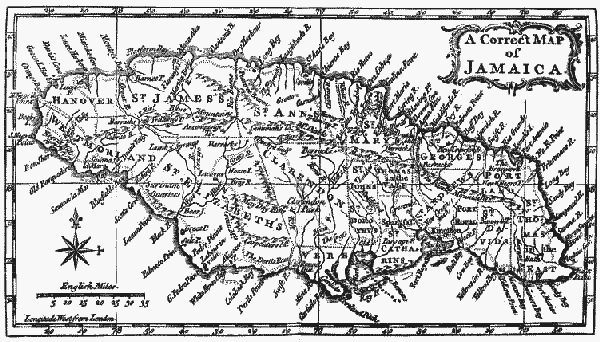
The capture of Jamaica by the
expedition sent out by Cromwell in
1655 was the blundering beginning of
a new era in West Indian history. It
was the first permanent annexation
by another European power of an
integral part of Spanish America.
Before 1655 the island had already
been twice visited by English
forces. The first occasion was in
January 1597, when Sir Anthony
Shirley, with little opposition,
took and plundered St. Jago de la
Vega. The second was in 1643, when
William Jackson repeated the same
exploit with 500 men from the
Windward Islands. Cromwell's
expedition, consisting of 2500 men
and a considerable fleet, set sail
from England in December 1654, with
the secret object of "gaining an
interest" in that part of the West
Indies in possession of the
Spaniards. Admiral Penn commanded
the fleet, and General Venables the
land forces.119
The expedition reached Barbadoes at
the end of January, where some 4000
additional troops were raised, besides about 1200 from
Nevis, St. Kitts, and neighbouring
islands. The commanders having
resolved to direct their first
attempt against Hispaniola, on 13th
April a landing was effected at a
point to the west of San Domingo,
and the army, suffering terribly
from a tropical sun and lack of
water, marched thirty miles through
woods and savannahs to attack the
city. The English received two
shameful defeats from a handful of
Spaniards on 17th and 25th April,
and General Venables, complaining
loudly of the cowardice of his men
and of Admiral Penn's failure to
co-operate with him, finally gave up
the attempt and sailed for Jamaica.
On 11th May, in the splendid harbour
on which Kingston now stands, the
English fleet dropped anchor. Three
small forts on the western side were
battered by the guns from the ships,
and as soon as the troops began to
land the garrisons evacuated their
posts. St. Jago, six miles inland,
was occupied next day. The terms
offered by Venables to the Spaniards
(the same as those exacted from the
English settlers on Providence
Island in 1641—emigration within ten
days on pain of death, and
forfeiture of all their property)
were accepted on the 17th; but the
Spaniards were soon discovered to
have entered into negotiations
merely to gain time and retire with
their families and goods to the
woods and mountains, whence they
continued their resistance.
Meanwhile the army, wretchedly
equipped with provisions and other
necessities, was decimated by
sickness. On the 19th two
long-expected store-ships arrived,
but the supplies brought by them
were limited, and an appeal for
assistance was sent to New England.
Admiral Penn, disgusted with the
fiasco in Hispaniola and on bad
terms with Venables, sailed for
England with part of his fleet on
25th June; and Venables, so ill that
his life was despaired of, and also
anxious to clear himself of the
responsibility for the initial
failure of the expedition, followed
in the "Marston Moor" nine days
later. On 20th September both
commanders appeared before the
Council of State to answer the
charge of having deserted their
posts, and together they shared the
disgrace of a month in the Tower.120

The army of General Venables was
composed of very inferior and
undisciplined troops, mostly the
rejected of English regiments or the
offscourings of the West Indian
colonies; yet the chief reasons for
the miscarriage before San Domingo
were the failure of Venables to
command the confidence of his
officers and men, his inexcusable
errors in the management of the
attack, and the lack of cordial
co-operation between him and the
Admiral. The difficulties with which
he had to struggle were, of course,
very great. On the other hand, he
seems to have been deficient both in
strength of character and in
military capacity; and his
ill-health made still more difficult
a task for which he was
fundamentally incompetent. The
comparative failure of this,
Cromwell's pet enterprise, was a
bitter blow to the Protector. For a
whole day he shut himself up in his
room, brooding over the disaster for
which he, more than any other, was
responsible. He had aimed not merely
to plant one more colony in America,
but to make himself master of such
parts of the West Indian islands and
Spanish Main as would enable him to
dominate the route of the
Spanish-American treasure fleets. To
this end Jamaica contributed few
advantages beyond those possessed by
Barbadoes and St. Kitts, and it was
too early for him to realize that
island for island Jamaica was much
more suitable than Hispaniola as the
seat of an English colony.121
Religious and economic motives
form the key to Cromwell's foreign
policy, and it is difficult to
discover which, the religious or
the economic, was uppermost in his
mind when he planned this
expedition. He inherited from the
Puritans of Elizabeth's time the
traditional religious hatred of
Spain as the bulwark of Rome, and in
his mind as in theirs the overthrow
of the Spaniards in the West Indies
was a blow at antichrist and an
extension of the true religion. The
religious ends of the expedition
were fully impressed upon Venables
and his successors in Jamaica.122
Second only, however, to Oliver's
desire to protect "the people of
God," was his ambition to extend
England's empire beyond the seas. He
desired the unquestioned supremacy
of England over the other nations of
Europe, and that supremacy, as he
probably foresaw, was to be
commercial and colonial. Since the
discovery of America the world's
commerce had enormously increased,
and its control brought with it
national power. America had become
the treasure-house of Europe. If
England was to be set at the head of
the world's commerce and navigation,
she must break through Spain's
monopoly of the Indies and gain a
control in Spanish America. San
Domingo was to be but a preliminary
step, after which the rest of the
Spanish dominions in the New World
would be gradually absorbed.123
The immediate excuse for the
attack on Hispaniola and Jamaica was
the Spaniards' practice of seizing
English ships and ill-treating
English crews merely because they
were found in some part of the
Caribbean Sea, and even though bound
for a plantation actually in
possession of English colonists. It
was the old question of effective
occupation versus papal
donation, and both Cromwell and Venables
convinced themselves that Spanish
assaults in the past on English
ships and colonies supplied a
sufficient casus belli.124
There was no justification, however,
for a secret attack upon Spain. She
had been the first to recognize the
young republic, and was willing and
even anxious to league herself with
England. There had been actual
negotiations for an alliance, and
Cromwell's offers, though rejected,
had never been really withdrawn.
Without a declaration of war or
formal notice of any sort, a fleet
was fitted out and sent in utmost
secrecy to fall unawares upon the
colonies of a friendly nation. The
whole aspect of the exploit was
Elizabethan. It was inspired by
Drake and Raleigh, a reversion to
the Elizabethan gold-hunt. It was
the first of the great buccaneering
expeditions.125
Cromwell was doubtless
influenced, too, by the
representations of Thomas Gage. Gage
was an Englishman who had joined the
Dominicans and had been sent by his
Order out to Spanish America. In
1641 he returned to England,
announced his conversion to
Protestantism, took the side of
Parliament and became a minister.
His experiences in the West Indies
and Mexico he published in 1648
under the name of "The
English-American, or a New Survey of
the West Indies," a most
entertaining book, which aimed to
arouse Englishmen against Romish
"idolatries," to show how valuable
the Spanish-American provinces might
be to England in trade and bullion
and how easily they might be seized.
In the summer of 1654, moreover,
Gage had laid before the Protector a
memorial in which he recapitulated
the conclusions of his book,
assuring Cromwell that the Spanish
colonies were sparsely peopled and
that the few whites were unwarlike
and scantily provided with arms and
ammunition. He asserted that the
conquest of Hispaniola and Cuba
would be a matter of no difficulty,
and that even Central America was
too weak to oppose a long
resistance.126
All this was true, and had Cromwell
but sent a respectable force under
an efficient leader the result would
have been different. The exploits of
the buccaneers a few years later
proved it.
It was fortunate, considering the
distracted state of affairs in
Jamaica in 1655-56, that the
Spaniards were in no condition to
attempt to regain the island. Cuba,
the nearest Spanish territory to
Jamaica, was being ravaged by the
most terrible pestilence known there
in years, and the inhabitants,
alarmed for their own safety,
instead of trying to dispossess the
English, were busy providing for the
defence of their own coasts.127
In 1657, however, some troops under
command of the old Spanish governor
of Jamaica, D. Christopher Sasi
Arnoldo, crossed from St. Jago de
Cuba and entrenched themselves on
the northern shore as the advance
post of a greater force expected
from the mainland. Papers of
instructions relating to the
enterprise were intercepted by
Colonel Doyley, then acting-governor
of Jamaica; and he with 500 picked
men embarked for the north side,
attacked the Spaniards in their
entrenchments and utterly routed
them.128
The next year about 1000 men, the
long-expected corps of regular
Spanish infantry, landed and erected
a fort at Rio Nuevo. Doyley,
displaying the same energy, set out
again on 11th June with 750 men,
landed under fire on the 22nd, and
next day captured the fort in a
brilliant attack in which about 300
Spaniards were killed and 100 more,
with many officers and flags,
captured. The English lost about
sixty in killed and wounded.129
After the failure of a similar,
though weaker, attempt in 1660, the
Spaniards despaired of regaining
Jamaica, and most of those still
upon the island embraced the first
opportunity to retire to Cuba and
other Spanish settlements.
As colonists the troops in
Jamaica proved to be very
discouraging material, and the army
was soon in a wretched state. The
officers and soldiers plundered and
mutinied instead of working and
planting. Their wastefulness led to
scarcity of food, and scarcity of
food brought disease and death.130
They wished to force the Protector to recall
them, or to employ them in
assaulting the opulent Spanish towns
on the Main, an occupation far more
lucrative than that of planting corn
and provisions for sustenance.
Cromwell, however, set himself to
develop and strengthen his new
colony. He issued a proclamation
encouraging trade and settlement in
the island by exempting the
inhabitants from taxes, and the
Council voted that 1000 young men
and an equal number of girls be
shipped over from Ireland. The
Scotch government was instructed to
apprehend and transport idlers and
vagabonds, and commissioners were
sent into New England and to the
Windward and Leeward Islands to try
and attract settlers.131
Bermudians, Jews, Quakers from
Barbadoes and criminals from
Newgate, helped to swell the
population of the new colony, and in
1658 the island is said to have
contained 4500 whites, besides 1500
or more negro slaves.132
To dominate the Spanish trade
routes was one of the principal
objects of English policy in the
West Indies. This purpose is
reflected in all of Cromwell's
instructions to the leaders of the
Jamaican design, and it appears
again in his instructions of 10th
October 1655 to Major-General
Fortescue and Vice-Admiral Goodson.
Fortescue was given power and
authority to land men upon territory
claimed by the Spaniards, to take
their forts, castles and places of
strength, and to pursue, kill and
destroy all who opposed him. The
Vice-Admiral was to assist him with
his sea-forces, and to use his best
endeavours to seize all ships belonging to the
King of Spain or his subjects in
America.133
The soldiers, as has been said, were
more eager to fight the Spaniards
than to plant, and opportunities
were soon given them to try their
hand. Admiral Penn had left twelve
ships under Goodson's charge, and of
these, six were at sea picking up a
few scattered Spanish prizes which
helped to pay for the victuals
supplied out of New England.134
Goodson, however, was after larger
prey, no less than the galleons or a
Spanish town upon the mainland. He
did not know where the galleons
were, but at the end of July he
seems to have been lying with eight
vessels before Cartagena and Porto
Bello, and on 22nd November he sent
Captain Blake with nine ships to the
same coast to intercept all vessels
going thither from Spain or
elsewhere. The fleet was broken up
by foul weather, however, and part
returned on 14th December to refit,
leaving a few small frigates to lie
in wait for some merchantmen
reported to be in that region.135
The first town on the Main to feel
the presence of this new power in
the Indies was Santa Marta, close to
Cartagena on the shores of what is
now the U.S. of Columbia. In the
latter part of October, just a month
before the departure of Blake,
Goodson sailed with a fleet of eight
vessels to ravage the Spanish
coasts. According to one account his
original design had been against Rio
de la Hacha near the pearl
fisheries, "but having missed his
aim" he sailed for Santa Marta. He
landed 400 sailors and soldiers
under the protection of his guns,
took and demolished the two forts
which barred his way, and entered
the town. Finding that the
inhabitants had already fled with as
much of their belongings as they
could carry, he pursued them some twelve miles
up into the country; and on his
return plundered and burnt their
houses, embarked with thirty pieces
of cannon and other booty, and
sailed for Jamaica.136
It was a gallant performance with a
handful of men, but the profits were
much less than had been expected. It
had been agreed that the seamen and
soldiers should receive half the
spoil, but on counting the proceeds
it was found that their share
amounted to no more than £400, to
balance which the State took the
thirty pieces of ordnance and some
powder, shot, hides, salt and Indian
corn.137
Sedgwick wrote to Thurloe that
"reckoning all got there on the
State's share, it did not pay for
the powder and shot spent in that
service."138
Sedgwick was one of the civil
commissioners appointed for the
government of Jamaica. A brave,
pious soldier with a long experience
and honourable military record in
the Massachusetts colony, he did not
approve of this type of warfare
against the Spaniards. "This kind of
marooning cruising West India trade
of plundering and burning towns," he
writes, "though it hath been long
practised in these parts, yet is not
honourable for a princely navy,
neither was it, I think, the work
designed, though perhaps it may be
tolerated at present." If Cromwell
was to accomplish his original
purpose of blocking up the Spanish
treasure route, he wrote again,
permanent foothold must be gained in
some important Spanish fortress,
either Cartagena or Havana, places
strongly garrisoned, however, and
requiring for their reduction a
considerable army and fleet, such as
Jamaica did not then possess. But to
waste and burn towns of inferior
rank without retaining them merely
dragged on the war indefinitely and
effected little advantage or profit
to anybody.139
Captain Nuberry visited Santa Marta
several weeks after Goodson's
descent, and, going on shore, found
that about a hundred people had made
bold to return and rebuild their
devastated homes. Upon sight of the
English the poor people again fled
incontinently to the woods, and
Nuberry and his men destroyed their
houses a second time.140
On 5th April 1656 Goodson, with
ten of his best ships, set sail
again and steered eastward along the
coast of Hispaniola as far as Alta
Vela, hoping to meet with some
Spanish ships reported in that
region. Encountering none, he stood
for the Main, and landed on 4th May
with about 450 men at Rio de la
Hacha. The story of the exploit is
merely a repetition of what happened
at Santa Marta. The people had sight
of the English fleet six hours
before it could drop anchor, and
fled from the town to the hills and
surrounding woods. Only twelve men
were left behind to hold the fort,
which the English stormed and took
within half an hour. Four large
brass cannon were carried to the
ships and the fort partly
demolished. The Spaniards pretended
to parley for the ransom of their
town, but when after a day's delay
they gave no sign of complying with
the admiral's demands, he burned the
place on 8th May and sailed away.141
Goodson called again at Santa Marta
on the 11th to get water, and on the
14th stood before Cartagena to view
the harbour. Leaving three vessels
to ply there, he returned to
Jamaica, bringing back with him only
two small prizes, one laden with
wine, the other with cocoa.
The seamen of the fleet, however,
were restless and eager for further
enterprises of this nature, and
Goodson by the middle of June had
fourteen of his vessels lying off
the Cuban coast near Cape S. Antonio
in wait for the galleons or the
Flota, both of which fleets were
then expected at Havana. His
ambition to repeat the achievement of Piet Heyn was fated
never to be realised. The fleet of
Terra-Firma, he soon learned, had
sailed into Havana on 15th May, and
on 13th June, three days before his
arrival on that coast, had departed
for Spain.142
Meanwhile, one of his own vessels,
the "Arms of Holland," was blown up,
with the loss of all on board but
three men and the captain, and two
other ships were disabled. Five of
the fleet returned to England on
23rd August, and with the rest
Goodson remained on the Cuban coast
until the end of the month, watching
in vain for the fleet from Vera Cruz
which never sailed.143
Colonel Edward Doyley, the
officer who so promptly defeated the
attempts of the Spaniards in 1657-58
to re-conquer Jamaica, was now
governor of the island. He had
sailed with the expedition to the
West Indies as lieutenant-colonel in
the regiment of General Venables,
and on the death of Major-General
Fortescue in November 1655 had been
chosen by Cromwell's commissioners
in Jamaica as commander-in-chief of
the land forces. In May 1656 he was
superseded by Robert Sedgwick, but
the latter died within a few days,
and Doyley petitioned the Protector
to appoint him to the post. William
Brayne, however, arrived from
England in December 1656 to take
chief command; and when he, like his
two predecessors, was stricken down
by disease nine months later, the
place devolved permanently upon
Doyley. Doyley was a very efficient
governor, and although he has been
accused of showing little regard or
respect for planting and trade, the charge appears to be
unjust.144
He firmly maintained order among men
disheartened and averse to
settlement, and at the end of his
service delivered up the colony a
comparatively well-ordered and
thriving community. He was confirmed
in his post by Charles II. at the
Restoration, but superseded by Lord
Windsor in August 1661. Doyley's
claim to distinction rests mainly
upon his vigorous policy against the
Spaniards, not only in defending
Jamaica, but by encouraging
privateers and carrying the war into
the enemies' quarters. In July 1658,
on learning from some prisoners that
the galleons were in Porto Bello
awaiting the plate from Panama,
Doyley embarked 300 men on a fleet
of five vessels and sent it to lie
in an obscure bay between that port
and Cartagena to intercept the
Spanish ships. On 20th October the
galleons were espied, twenty-nine
vessels in all, fifteen galleons and
fourteen stout merchantmen.
Unfortunately, all the English
vessels except the "Hector" and the
"Marston Moor" were at that moment
absent to obtain fresh water. Those
two alone could do nothing, but
passing helplessly through the
Spaniards, hung on their rear and
tried without success to scatter
them. The English fleet later
attacked and burnt the town of Tolu
on the Main, capturing two Spanish
ships in the road; and afterwards
paid another visit to the
unfortunate Santa Marta, where they
remained three days, marching
several miles into the country and
burning and destroying everything in
their path.145
On 23rd April 1659, however,
there returned to Port Royal another
expedition whose success realised
the wildest dreams of avarice. Three
frigates under command of Captain Christopher
Myngs,146
with 300 soldiers on board, had been
sent by Doyley to harry the South
American coast. They first entered
and destroyed Cumana, and then
ranging along the coast westward,
landed again at Puerto Cabello and
at Coro. At the latter town they
followed the inhabitants into the
woods, where besides other plunder
they came upon twenty-two chests of
royal treasure intended for the King
of Spain, each chest containing 400
pounds of silver.147
Embarking this money and other spoil
in the shape of plate, jewels and
cocoa, they returned to Port Royal
with the richest prize that ever
entered Jamaica. The whole pillage
was estimated at between £200,000
and £300,000.148
The abundance of new wealth
introduced into Jamaica did much to
raise the spirits of the colonists,
and set the island well upon the
road to more prosperous times. The
sequel to this brilliant exploit,
however, was in some ways
unfortunate. Disputes were
engendered between the officers of
the expedition and the governor and
other authorities on shore over the
disposal of the booty, and in the
early part of June 1659 Captain
Myngs was sent home in the "Marston
Moor," suspended for disobeying
orders and plundering the hold of
one of the prizes to the value of
12,000 pieces of eight. Myngs was an
active, intrepid commander, but
apparently avaricious and impatient
of control. He seems to
have endeavoured to divert most of
the prize money into the pockets of
his officers and men, by disposing
of the booty on his own initiative
before giving a strict account of it
to the governor or steward-general
of the island. Doyley writes that
there was a constant market aboard
the "Marston Moor," and that Myngs
and his officers, alleging it to be
customary to break and plunder the
holds, permitted the twenty-two
chests of the King of Spain's silver
to be divided among the men without
any provision whatever for the
claims of the State.149
There was also some friction over
the disposal of six Dutch prizes
which Doyley had picked up for
illegal trading at Barbadoes on his
way out from England. These, too,
had been plundered before they
reached Jamaica, and when Myngs
found that there was no power in the
colony to try and condemn ships
taken by virtue of the Navigation
Laws, it only added fuel to his
dissatisfaction. When Myngs reached
England he lodged counter-complaints
against Governor Doyley, Burough,
the steward-general, and
Vice-Admiral Goodson, alleging that
they received more than their share
of the prize money; and a war of
mutual recrimination followed.150
Amid the distractions of the
Restoration, however, little seems
ever to have been made of the matter
in England. The insubordination of
officers in 1659-60 was a constant
source of difficulty and impediment
to the governor in his efforts to
establish peace and order in the
colony. In England nobody was sure
where the powers of government
actually resided. As Burough wrote
from Jamaica on 19th January 1660,
"We are here just like you at home;
when we heard of the
Lord-Protector's death we proclaimed his
son, and when we heard of his being
turned out we proclaimed a
Parliament and now own a Committee
of safety."151
The effect of this uncertainty was
bound to be prejudicial in Jamaica,
a new colony filled with
adventurers, for it loosened the
reins of authority and encouraged
lawless spirits to set the governor
at defiance.
On 8th May 1660 Charles II. was
proclaimed King of England, and
entered London on 29th May. The war
which Cromwell had begun with Spain
was essentially a war of the
Commonwealth. The Spanish court was
therefore on friendly terms with the
exiled prince, and when he returned
into possession of his kingdom a
cessation of hostilities with Spain
naturally followed. Charles wrote a
note to Don Luis de Haro on 2nd June
1660, proposing an armistice in
Europe and America which was to lead
to a permanent peace and a
re-establishment of commercial
relations between the two kingdoms.152
At the same time Sir Henry Bennett,
the English resident in Madrid, made
similar proposals to the Spanish
king. A favourable answer was
received in July, and the cessation
of arms, including a revival of the
treaty of 1630 was proclaimed on
10th-20th September 1660.
Preliminary negotiations for a new
treaty were entered upon at Madrid,
but the marriage of Charles to
Catherine of Braganza in 1662, and
the consequent alliance with
Portugal, with whom Spain was then
at war, put a damper upon all such
designs. The armistice with Spain
was not published in Jamaica until
5th February of the following year.
On 4th February Colonel Doyley
received from the governor of St.
Jago de Cuba a letter enclosing an
order from Sir Henry Bennett for the
cessation of arms, and this order
Doyley immediately made public.153 About thirty English
prisoners were also returned by the
Spaniards with the letter. Doyley
was confirmed in his command of
Jamaica by Charles II., but his
commission was not issued till 8th
February 1661.154
He was very desirous, however, of
returning to England to look after
his private affairs, and on 2nd
August another commission was issued
to Lord Windsor, appointing him as
Doyley's successor.155
Just a year later, in August 1662,
Windsor arrived at Port Royal,
fortified with instructions "to
endeavour to obtain and preserve a
good correspondence and free
commerce with the plantations
belonging to the King of Spain,"
even resorting to force if
necessary.156
The question of English trade
with the Spanish colonies in the
Indies had first come to the surface
in the negotiations for the treaty
of 1604, after the long wars between
Elizabeth and Philip II. The
endeavour of the Spaniards to obtain
an explicit prohibition of commerce
was met by the English demand for
entire freedom. The Spaniards
protested that it had never been
granted in former treaties or to
other nations, or even without
restriction to Spanish subjects, and
clamoured for at least a private
article on the subject; but the
English commissioners steadfastly
refused, and offered to forbid trade
only with ports actually under
Spanish authority. Finally a
compromise was reached in the words
"in quibus ante bellum fuit
commercium, juxta et secundum usum
et observantiam."157
This article was renewed in
Cottington's Treaty of 1630. The
Spaniards themselves, indeed, in
1630, were willing to concede a free
navigation in the American seas, and
even offered to recognise the
English colony of Virginia if
Charles I. would admit articles
prohibiting trade and navigation in
certain harbours and bays.
Cottington, however, was too
far-sighted, and wrote to Lord
Dorchester: "For my own part, I
shall ever be far from advising His
Majesty to think of such
restrictions, for certainly a little
more time will open the navigation
to those parts so long as there are
no negative capitulations or
articles to hinder it."158
The monopolistic pretensions of the
Spanish government were evidently
relaxing, for in 1634 the Conde de
Humanes confided to the English
agent, Taylor, that there had been
talk in the Council of the Indies of
admitting the English to a share in
the freight of ships sent to the
West Indies, and even of granting
them a limited permission to go to
those regions on their own account.
And in 1637 the Conde de Linhares,
recently appointed governor of
Brazil, told the English ambassador,
Lord Aston, that he was very anxious
that English ships should do the
carrying between Lisbon and
Brazilian ports.
The settlement of the Windward
and Leeward Islands and the conquest
of Jamaica had given a new impetus
to contraband trade. The commercial
nations were setting up shop, as it
were, at the very doors of the
Spanish Indies. The French and
English Antilles, condemned by the
Navigation Laws to confine
themselves to agriculture and a
passive trade with the home country,
had no recourse but to traffic with
their Spanish neighbours. Factors of the Assiento
established at Cartagena, Porto
Bello and Vera Cruz every year
supplied European merchants with
detailed news of the nature and
quantity of the goods which might be
imported with advantage; while the
buccaneers, by dominating the whole
Caribbean Sea, hindered frequent
communication between Spain and her
colonies. It is not surprising,
therefore, that the commerce of
Seville, which had hitherto held its
own, decreased with surprising
rapidity, that the sailings of the
galleons and the Flota were
separated by several years, and that
the fairs of Porto Bello and Vera
Cruz were almost deserted. To put an
effective restraint, moreover, upon
this contraband trade was impossible
on either side. The West Indian
dependencies were situated far from
the centre of authority, while the
home governments generally had their
hands too full of other matters to
adequately control their subjects in
America. The Spanish viceroys,
meanwhile, and the governors in the
West Indian Islands, connived at a
practice which lined their own
pockets with the gold of bribery,
and at the same time contributed to
the public interest and prosperity
of their respective colonies. It was
this illicit commerce with Spanish
America which Charles II., by
negotiation at Madrid and by
instructions to his governors in the
West Indies, tried to get within his
own control. At the Spanish court,
Fanshaw, Sandwich and Godolphin in
turn were instructed to sue for a
free trade with the Colonies. The
Assiento of negroes was at this time
held by two Genoese named Grillo and
Lomelin, and with them the English
ambassadors several times entered
into negotiation for the privilege
of supplying blacks from the English
islands. By the treaty of 1670 the
English colonies in America were for
the first time formally recognised
by the Spanish Crown. Freedom of
commerce, however, was as far as
ever from realisation, and after
this date Charles seems to have given up
hope of ever obtaining it through
diplomatic channels.
The peace of 1660 between England
and Spain was supposed to extend to
both sides of the "Line." The
Council in Jamaica, however, were of
the opinion that it applied only to
Europe,159
and from the tenor of Lord Windsor's
instructions it may be inferred that
the English Court at that time meant
to interpret it with the same
limitations. Windsor, indeed, was
not only instructed to force the
Spanish colonies to a free trade,
but was empowered to call upon the
governor of Barbadoes for aid "in
case of any considerable attempt by
the Spaniards against Jamaica."160
The efforts of the Governor,
however, to come to a good
correspondence with the Spanish
colonies were fruitless. In the
minutes of the Council of Jamaica of
20th August 1662, we read: "Resolved
that the letters from the Governors
of Porto Rico and San Domingo are an
absolute denial of trade, and that
according to His Majesty's
instructions to Lord Windsor a trade
by force or otherwise be
endeavoured;"161
and under 12th September we find
another resolution "that men be
enlisted for a design by sea with
the 'Centurion' and other vessels."162
This "design" was an expedition to
capture and destroy St. Jago de
Cuba, the Spanish port nearest to
Jamaican shores. An attack upon St.
Jago had been projected by Goodson
as far back as 1655. "The Admiral,"
wrote Major Sedgwick to Thurloe just
after his arrival in Jamaica, "was
intended before our coming in to
have taken some few soldiers and
gone over to St. Jago de Cuba, a
town upon Cuba, but our coming
hindered him without whom we could
not well tell how to do anything."163
In January 1656 the plan was
definitely abandoned, because the colony could not
spare a sufficient number of
soldiers for the enterprise.164
It was to St. Jago that the
Spaniards, driven from Jamaica,
mostly betook themselves, and from
St. Jago as a starting-point had
come the expedition of 1658 to
reconquer the island. The
instructions of Lord Windsor
afforded a convenient opportunity to
avenge past attacks and secure
Jamaica from molestation in that
quarter for the future. The command
of the expedition was entrusted to
Myngs, who in 1662 was again in the
Indies on the frigate "Centurion."
Myngs sailed from Port Royal on 21st
September with eleven ships and 1300
men,165
but, kept back by unfavourable
winds, did not sight the castle of
St. Jago until 5th October. Although
he had intended to force the
entrance of the harbour, he was
prevented by the prevailing land
breeze; so he disembarked his men to
windward, on a rocky coast, where
the path up the bluffs was so narrow
that but one man could march at a
time. Night had fallen before all
were landed, and "the way (was) soe
difficult and the night soe dark
that they were forced to make stands
and fires, and their guides with
brands in their hands, to beat the
path."166
At daybreak they reached a
plantation by a river's side, some
six miles from the place of landing
and three from St. Jago. There they
refreshed themselves, and advancing
upon the town surprised the enemy,
who knew of the late landing and the
badness of the way and did not
expect them so soon. They found 200
Spaniards at the entrance to the
town, drawn up under their governor,
Don Pedro de Moralis, and supported
by Don Christopher de Sasi Arnoldo,
the former Spanish governor of
Jamaica, with a reserve of 500 more.
The Spaniards fled before the first
charge of the Jamaicans, and the
place was easily mastered.
The next day parties were
despatched into the country to
pursue the enemy, and orders sent to
the fleet to attack the forts at the
mouth of the harbour. This was
successfully done, the Spaniards
deserting the great castle after
firing but two muskets. Between
scouring the country for hidden
riches, most of which had been
carried far inland beyond their
reach, and dismantling and
demolishing the forts, the English
forces occupied their time until
October 19th. Thirty-four guns were
found in the fortifications and 1000
barrels of powder. Some of the guns
were carried to the ships and the
rest flung over the precipice into
the sea; while the powder was used
to blow up the castle and the
neighbouring country houses.167
The expedition returned to Jamaica
on 22nd October.168
Only six men had been killed by the
Spaniards, twenty more being lost by
other "accidents." Of these twenty
some must have been captured by the
enemy, for when Sir Richard Fanshaw
was appointed ambassador to Spain in
January 1664, he was instructed
among other things to negotiate for
an exchange of prisoners taken in
the Indies. In July we find him
treating for the release of Captain
Myngs' men from the prisons of
Seville and Cadiz,169
and on 7th November an order to this
effect was obtained from the King of
Spain.170
The instructions of Lord Windsor
gave him leave, as soon as he had
settled the government in Jamaica,
to appoint a deputy and return to
England to confer with the King on
colonial affairs. Windsor sailed for
England on 28th October, and on the
same day Sir Charles Lyttleton's
commission as deputy-governor was
read in the Jamaican Council.171
During his short sojourn of three
months the Governor had made
considerable progress toward
establishing an ordered constitution
in the island. He disbanded the old
army, and reorganised the military
under a stricter discipline and
better officers. He systematised
legal procedure and the rules for
the conveyance of property. He
erected an Admiralty Court at Port
Royal, and above all, probably in
pursuance of the recommendation of
Colonel Doyley,172
had called in all the privateering
commissions issued by previous
governors, and tried to submit the
captains to orderly rules by giving
them new commissions, with
instructions to bring their Spanish
prizes to Jamaica for judicature.173
The departure of Windsor did not
put a stop to the efforts of the
Jamaicans to "force a trade" with
the Spanish plantations, and we find
the Council, on 11th December 1662,
passing a motion that to this end an
attempt should be made to leeward on
the coasts of Cuba, Honduras and the
Gulf of Campeache. On 9th and 10th
January between 1500 and 1600
soldiers, many of them doubtless
buccaneers, were embarked on a fleet
of twelve ships and sailed two days
later under command of the
redoubtable Myngs. About ninety
leagues this side of Campeache the
fleet ran into a great storm, in
which one of the vessels foundered
and three others were separated from
their fellows. The English reached
the coast of Campeache, however, in
the early morning of Friday, 9th
February, and landing a league and a
half from the town, marched without
being seen along an Indian path with
"such speed and good fortune" that
by ten o'clock in the morning they
were already masters of the city and
of all the forts save one, the
Castle of Santa Cruz. At the second
fort Myngs was wounded by a gun in
three places. The town itself, Myngs
reported, might have been defended
like a fortress, for the houses were contiguous and
strongly built of stone with flat
roofs.174
The forts were partly demolished, a
portion of the town was destroyed by
fire, and the fourteen sail lying in
the harbour were seized by the
invaders. Altogether the booty must
have been considerable. The Spanish
licentiate, Maldonado de Aldana,
placed it at 150,000 pieces of
eight,175
and the general damage to the city
in the destruction of houses and
munitions by the enemy, and in the
expenditure of treasure for purposes
of defence, at half a million more.
Myngs and his fleet sailed away on
23rd February, but the "Centurion"
did not reach Port Royal until 13th
April, and the rest of the fleet
followed a few days later. The
number of casualties on each side
was surprisingly small. The invaders
lost only thirty men killed, and the
Spaniards between fifty and sixty,
but among the latter were the two
alcaldes and many other officers and
prominent citizens of the town.176
To satisfactorily explain at
Madrid these two presumptuous
assaults upon Spanish territory in
America was an embarrassing
problem for the English Government,
especially as Myngs' men imprisoned
at Seville and Cadiz were said to
have produced commissions to justify
their actions.177
The Spanish king instructed his
resident in London to demand whether
Charles accepted responsibility for
the attack upon St. Jago, and the
proceedings of English cases in the
Spanish courts arising from the
depredations of Galician corsairs
were indefinitely suspended.178
When, however, there followed upon
this, in May 1663, the news of the
sack and burning of Campeache, it
stirred up the greatest excitement
in Madrid.179
Orders and, what was rarer in Spain,
money were immediately sent to Cadiz
to the Duke of Albuquerque to hasten
the work on the royal Armada for
despatch to the Indies; and efforts
were made to resuscitate the defunct
Armada de Barlovento, a small fleet
which had formerly been used to
catch interlopers and protect the
coasts of Terra-Firma. In one way
the capture of Campeache had touched
Spain in her most vulnerable spot.
The Mexican Flota, which was
scheduled to sail from Havana in
June 1663, refused to stir from its
retreat at Vera Cruz until the
galleons from Porto Bello came to
convoy it. The arrival of the
American treasure in Spain was thus
delayed for two months, and the
bankrupt government put to sore
straits for money.
The activity of the Spaniards,
however, was merely a blind to hide
their own impotence, and their
clamours were eventually satisfied
by the King of England's writing to
Deputy-Governor Lyttleton a letter
forbidding all such undertakings for
the future. The text of the letter
is as follows: "Understanding with
what jealousy and offence the
Spaniards look upon our island of
Jamaica, and how disposed they are
to make some attempt upon it, and knowing how disabled it
will remain in its own defence if
encouragement be given to such
undertakings as have lately been set
on foot, and are yet pursued, and
which divert the inhabitants from
that industry which alone can render
the island considerable, the king
signifies his dislike of all such
undertakings, and commands that no
such be pursued for the future, but
that they unitedly apply themselves
to the improvement of the plantation
and keeping the force in proper
condition."180
The original draft of the letter was
much milder in tone, and betrays the
real attitude of Charles II. toward
these half-piratical enterprises:
"His Majesty has heard of the
success of the undertaking upon
Cuba, in which he cannot choose but
please himself in the vigour and
resolution wherein it was performed
... but because His Majesty cannot
foresee any utility likely to arise
thereby ... he has thought fit
hereby to command him to give no
encouragement to such undertakings
unless they may be performed by the
frigates or men-of-war attending
that place without any addition from
the soldiers or inhabitants."181
Other letters were subsequently sent
to Jamaica, which made it clear that
the war of the privateers was not
intended to be called off by the
king's instructions; and Sir Charles
Lyttleton, therefore, did not recall
their commissions. Nevertheless, in
the early part of 1664, the assembly
in Jamaica passed an act prohibiting
public levies of men upon foreign
designs, and forbidding any person
to leave the island on any such
design without first obtaining leave
from the governor, council and
assembly.182
When the instructions of the
authorities at home were so
ambiguous, and the incentives to
corsairing so alluring, it was
natural that this game of baiting
the Spaniards should suffer little
interruption. English freebooters
who had formerly made Hispaniola and
Tortuga their headquarters now
resorted to Jamaica, where they
found a cordial welcome and a better
market for their plunder. Thus in
June 1663 a certain Captain Barnard
sailed from Port Royal to the
Orinoco, took and plundered the town
of Santo Tomas and returned in the
following March.183
On 19th October another privateer
named Captain Cooper brought into
Port Royal two Spanish prizes, the
larger of which, the "Maria" of
Seville, was a royal azogue and
carried 1000 quintals of quicksilver
for the King of Spain's mines in
Mexico, besides oil, wine and
olives.184
Cooper in his fight with the smaller
vessel so disabled his own ship that
he was forced to abandon it and
enter the prize; and it was while
cruising off Hispaniola in this
prize that he fell in with the
"Maria," and captured her after a
four hours' combat. There were
seventy prisoners, among them a
number of friars going to Campeache
and Vera Cruz. Some of the prize
goods were carried to England, and
Don Patricio Moledi, the Spanish
resident in London, importuned the
English government for its
restoration.185
Sir Charles Lyttleton had sailed for
England on 2nd May 1664, leaving the
government of Jamaica in the hands
of the Council with Colonel Thomas
Lynch as president;186
and on his arrival in England he
made formal answer to the complaints
of Moledi. His excuse was that
Captain Cooper's commission had been
derived not from the deputy-governor
himself but from Lord Windsor; and
that the deputy-governor had never
received any order from the king for
recalling commissions, or for the
cessation of hostilities against the
Spaniards.187
Lyttleton and the English
government were evidently attempting
the rather difficult circus feat of
riding two mounts at the same time.
The instructions from England, as
Lyttleton himself acknowledged in
his letter of 15th October 1663,
distinctly forbade further
hostilities against the Spanish
plantations; on the other hand,
there were no specific orders that
privateers should be recalled.
Lyttleton was from first to last in
sympathy with the freebooters, and
probably believed with many others
of his time that "the Spaniard is
most pliable when best beaten." In
August 1664 he presented to the Lord
Chancellor his reasons for
advocating a continuance of the
privateers in Jamaica. They are
sufficiently interesting to merit a
résumé of the principal
points advanced. 1st. Privateering
maintained a great number of seamen
by whom the island was protected
without the immediate necessity of a
naval force. 2nd. If privateering
were forbidden, the king would lose
many men who, in case of a war in
the West Indies, would be of
incalculable service, being
acquainted, as they were, with the
coasts, shoals, currents, winds,
etc., of the Spanish dominions. 3rd.
Without the privateers, the
Jamaicans would have no intelligence
of Spanish designs against them, or
of the size or neighbourhood of
their fleets, or of the strength of
their resources. 4th. If prize-goods
were no longer brought into Port
Royal, few merchants would resort to
Jamaica and prices would become
excessively high. 5th. To reduce the
privateers would require a large
number of frigates at considerable
trouble and expense; English seamen,
moreover, generally had the
privateering spirit and would be
more ready to join with them than
oppose them, as previous experience
had shown. Finally, the privateers,
if denied the freedom of Jamaican
ports, would not take to planting,
but would resort to the islands of
other nations, and perhaps prey upon
English commerce.188 |